
The March to the Dream
by Kitty Kelley
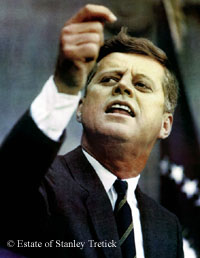 President Kennedy had to be pushed but after two bloody summers of Freedom Riders, television coverage of Bull Connors’ police dogs chewing children to bits, police men clubbing peaceful demonstrators and fire hoses slamming children against jagged brick buildings, leaving them torn and bleeding, JFK found his voice. He watched with disgust as Alabama Governor George Wallace, who had pledged “Segregation now. Segregation tomorrow. Segregation forever,” threatened to stand in the school house door to prevent two black students from integrating the state’s all-white university. That evening, June 11, 1963, John F. Kennedy ennobled his presidency with an address to the nation on equal rights:
We are confronted primarily with a moral issue. It is as old as the Scriptures and as clear as the American Constitution…. If an American, because his skin is dark, cannot eat lunch in a restaurant open to the public, if he cannot send his children to the best schools available, if he cannot vote for the public officials who represent him…then who among us would be content to have the color of his skin changed? Who among us would then be content with counsels of patience and delay?
Next week I shall ask the Congress of the United States to make a commitment it has not fully made in this country to the proposition that race has no place in American life or law.
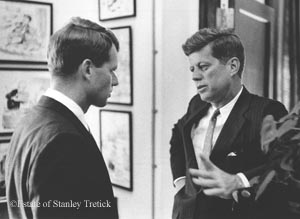 The President’s approval plummeted from 60 to 47 percent after his speech, and he and his brother, Attorney General Robert F. Kennedy, began counseling “patience and delay,” pleading with Civil Rights leaders to call off their scheduled March on Washington for Jobs and Freedom. Fearing violence and re-election in 1964, the administration said the March would do more harm than good. “We want success in Congress, not a big show at the Capital,” said the President.
Kennedy summoned Civil Rights leaders to the White House to try to dissuade them but they remained resolute. The President relented and then called his brother: “Well, if we can’t stop them, we’ll run the damned thing.”
The March organizers agreed to demonstrate on a Wednesday so people would get back to their jobs and not stay the week-end. Parade permits were granted from 9 a.m to 5 p.m so that marchers would leave the city before dark. Schools, bars, restaurants and stores were closed. All elective surgeries in area hospitals were cancelled to free up 340 beds for riot-related emergencies. 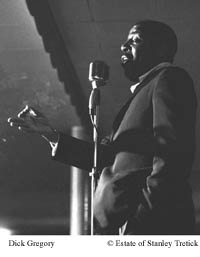 The DC National Guard spent the summer training for riot duty and 2400 Guardsmen were sworn in as “special officers” with temporary arrest power. The city, including leaders like Mrs. Agnes E. Meyer, whose family owned The Washington Post and Newsweek, predicted “catastrophic outbreaks of violence, bloodshed and property damage.” The government closed the day of the March and federal employees were told to stay home.
The comedian Dick Gregory was amused by the fears of the white establishment. “I know the senators and congressmen are scared of what’s going to happen,” he said. “[But] I’ll tell you what’s going to happen. It’s going to be a great Sunday picnic.” To the Kennedy administration it looked like it was going to be a great big political fiasco.
Weeks in advance, the March, set for August 28, 1963, became global news as Civil Rights activists around the world announced that they, too, would march in Berlin, Munich, Amsterdam, London, Oslo, Madrid, The Hague, Tel Aviv, Cairo, Toronto, and Kingston, Jamaica. 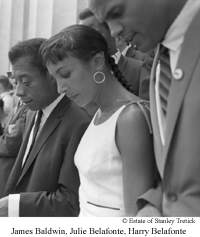 Celebrities chartered planes from Hollywood’s progressive community, including Harry Belafonte, Paul Newman, Marlon Brando, Gregory Peck, Billy Eckstein, Lena Horne, Sidney Poitier, Sammy Davis, Jr., Tony Bennett, even Charleton Heston. Burt Lancaster flew from his movie location in Paris, and the dancer and jazz singer Josephine Baker arrived from France in her Free French uniform.
Even with unprecedented police presence on the Mall, the President was so concerned about hot rhetoric stirring the crowds to violence that he positioned one of his advance men behind the sound system at the Lincoln Memorial ready to flip a special switch to cut the public address system, if necessary, and play a recording of Mahalia Jackson singing, “He’s Got the Whole World in His Hands.”
The day dawned with Washington’s usual summer swamp humidity but most of the 250,000 marchers arrived in their Sunday best. Women donned hats and high heels; men wore white shirts and ties. They dressed for church; their mission was religious—to heal sick hearts and open closed minds.
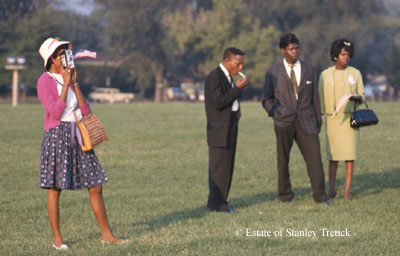
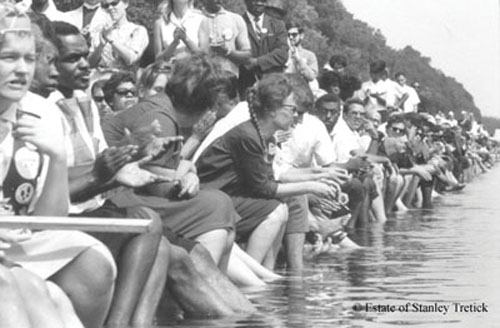
They marched and sang and swayed to the soaring sounds of the Freedom Singers and Odetta and Marian Anderson; they sat ten- deep at the Reflecting Pool, many dangling their feet in the water like pilgrims who once gathered at the Sea of Galilee.
They cheered the speakers, and then they rose and roared in unison for the spell-binding finale of Martin Luther King, Jr., who had come to tell them about his dream for America “that one day the nation will rise up and live out the true meaning
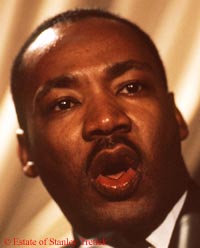 of its creed: ‘We hold these truths to be self-evident, that all men are created equal.’”
The vast throng of humanity erupted into thunderous applause with each crescendo of Dr. King’s dream. In the rising cadence of a master spell-binder, he told America that if it was to become a great nation, it must make the dream of freedom come true for its black citizens. Even President Kennedy, watching on television, was transfixed. “He’s good. He’s damn good.”
The President had refused to participate in the March, but he invited the Civil Rights leaders to the White House at the end of the day. He greeted Dr. King by shaking his hand and saying, “I have a dream.”
Bubbling over with the success of the day which had occurred without one incident of violence, the President told reporters that he was edified by the speeches, the singing, the crowds—the entire event. “The nation can be properly proud of this march,” he said.

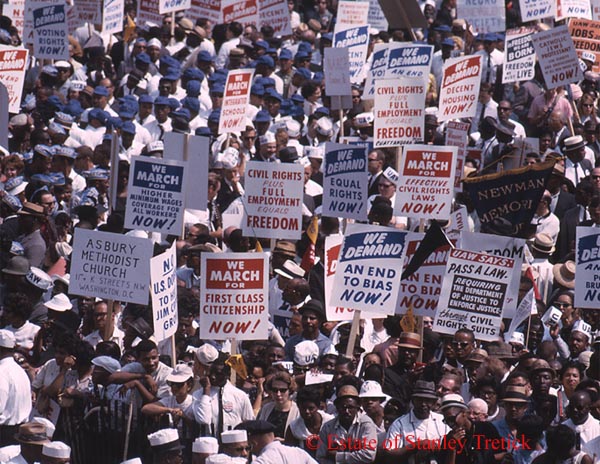
Photos from Let Freedom Ring: Stanley Tretick’s Iconic Images of the March on Washington, ©Estate of Stanley Tretick, used with permission.
Buy: Amazon Barnes & Noble Books-A-Million Apple IndieBound
Cross-posted from Huffington Post
Rose Kennedy: The Life and Times of a Political Matriarch
by Kitty Kelley
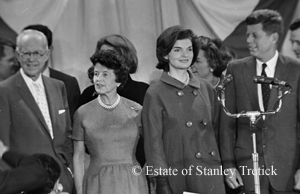 Anyone who has followed the Kennedys knows the bar is high for books on the subject. Having been inundated for the past 50 years with hundreds of biographies and memoirs and profiles about the spellbinding mystique of John Fitzgerald Kennedy, his family and his thousand days as the country’s first Irish-Catholic president, we expect each publication to bring something new and fresh to add to our understanding of the family that refashioned politics in the 20th century.
Serious historians (Arthur Schlesinger, Jr., William Manchester, James MacGregor Burns, Nigel Hamilton), journalists (Seymour Hersh, Jack Newfield, Warren Rogers), conspiracy theorists (Jim Garrison), commercial clip-and-pasters (Laurence Leamer, Christopher Anderson) and friends (Paul “Red” Fay, Benjamin C. Bradlee) have tried to capture the firefly magic of the Kennedys, while antagonists (Victor Lasky, Ralph de Taledano) have tried to puncture their myth.
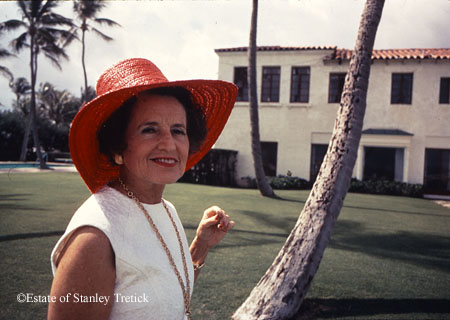
So now comes Barbara A. Perry with Rose Kennedy: The Life and Times of a Political Matriarch, who promises to deliver “the definitive biography” of the woman whose iron-fisted image-making produced the mystique that continues to endure. When the John F. Kennedy Library released the papers of the president’s mother (300 boxes) in 2006, Perry, a senior fellow in presidential oral history at the University of Virginia’s Miller Center in Charlottesville, was first in line, but, alas, Rose had no secrets beyond the few she revealed in her 1974 memoir, Times to Remember. As a biographer Perry was challenged. After six years of research and writing, she bowed to the obvious: With nothing new, she went for nuance. Her text is well written and her bibliography shows research, but there is no gold in the mine.
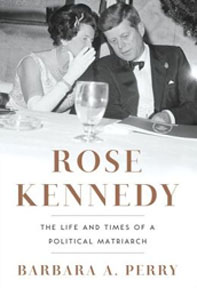 Her book cover, though, is perfect, absolutely perfect, because it captures the essence of Rose Fitzgerald Kennedy. The black-and-white photograph shows a woman who later died at the age of 104 after living her life by the black-and-white strictures of the Catholic Church, pre-Vatican II. Still glamorous at the age of 73, she is sitting next to the handsome president at a White House state dinner in 1963. She is acting as her son’s hostess because the first lady is away on one of her many vacations, similar to the ones Rose took for six to eight weeks at a time to get away from the clamor of her large family, and possibly, according to her biographer, as a means of Church-approved birth control. Rose is wearing the Molyneux gown she wore when she was 48 and her husband, Joseph P. Kennedy, was presented to the king and queen of England as the U.S. ambassador to the Court of St. James. That was the crowning glory of Rose’s life: To be accepted by British royalty was beyond the biggest dreams of a little girl from Dorchester, Mass.
Bejeweled with two diamond clips in her hair, diamonds dripping from her ears, a triple strand of pearls the size of grapes circling her unlined neck and a bracelet of diamonds wrapped around her arm, which is encased in a long white kid-leather glove, Rose is whispering in her son’s ear. 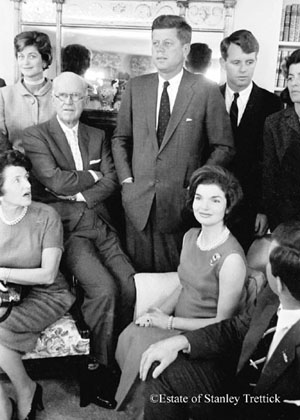 Ever the canny pol, she covers her mouth so the photographer cannot catch a candid shot. (“I do not like candid pictures,” she said. “They are so unattractive.”)
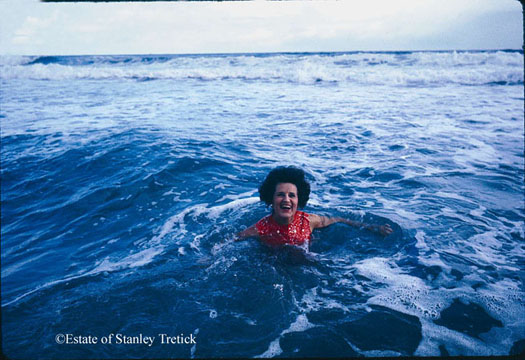
Oh, did I mention that the Molyneux gown was sleeveless? This is a detail Rose would want to have emphasized because she prided herself on her petite figure and frequently said that after having nine children she could still wear a size 8. Her frenetic exercise routine of swimming in the ocean every day, playing golf, walking miles, eating sparingly and rarely drinking had left her sleek and svelte with tanned, taut arms.
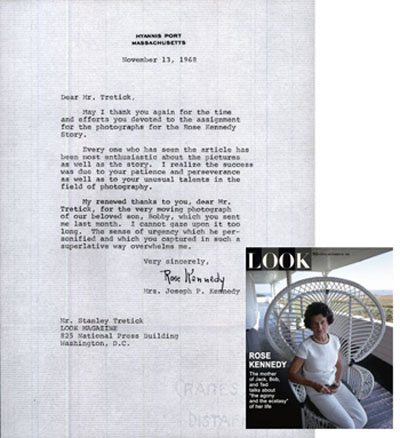
Appearances ruled Rose, and nothing mattered to her as much as how one looked — in person and in pictures. She made her children line up for daily inspections so she could see if their shoes were shined and their buttons attached. She saw each child as a reflection of herself and of the family name her husband was making famous on Wall Street and in Hollywood, so she strove for perfection, demanding it of herself and everyone around her. A martinet mother, she insisted her children brush their teeth three times a day and say their prayers every night. They were instructed to make meals on time or go without eating, and en route to the dining room they were required to check the bulletin board for the topics of current affairs that were to be discussed at dinner. Rose was the parent in charge of their childhood. When they became young adults her husband took over, but as one daughter said, “Dad gave us many lovely things but mother gave us our character.”
Despite her foibles and her husband’s philandering Rose relied on her strong religious faith to survive the worst tragedies of her life, and she managed to produce an extraordinary family of sons and daughters, who cared for each other, supported each other and remained close throughout their lives — and that is a mother’s finest legacy. Rose Fitzgerald Kennedy is an admirable subject but one that left her admiring biographer empty-handed.
 Kitty Kelley’s seven biographies include Jackie Oh! (1978), the first book to reveal that the former first lady suffered from depression and was treated with electroshock therapy; it also reported for the first time that Rosemary Kennedy survived the mangled lobotomy her father had ordered in hopes of reversing her mental retardation. In 1988, People published Kelley’s story detailing President Kennedy’s affair with a woman who carried his messages to her other lover, mobster Sam Giancana.
Cross-posted with Washington Independent Review of Books.
Photos from Capturing Camelot ©Estate of Stanley Tretick, used with permission.
Gaithersburg Book Festival
On May 18, 2013 (Saturday), Kitty Kelley will be appearing at the Gaithersburg Book Festival, Gathersburg MD. Author presentation at James Michener Pavilion, 1:15 pm to 2:05 pm. Book signing (Capturing Camelot) 2:15 to 3:05 pm, Politics and Prose Signing Area. Click here for more details.
Goosey Lucy and Gay Marriage
by Kitty Kelley
Gay marriage has jumped out of the closet on to the front page. Everyone from the President of the U.S. to retired four star general Colin Powell is embracing the issue, now supported by most Americans. Still, a few people like former First Lady Laura Bush appear to be conflicted. This week Mrs. Bush, who publicly supported gay marriage, now objects to appearing in an ad that carries her words of support.
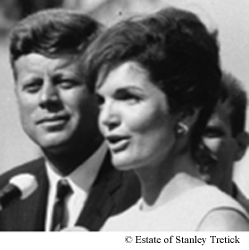 Presidents often disappoint, but first ladies rarely do. I became a student (and secret admirer) of first ladies after writing biographies of Jacqueline Kennedy Onassis (1978), Nancy Reagan (1991) and Barbara and Laura Bush (2004). Through years of research and reporting I’ve watched these unelected women enhance the presidencies of their spouses through deed and demeanor. They all seem to do it with style and grace and as a result they usually become even more popular than their beleaguered husbands (Lady Bird Johnson, Betty Ford and Michelle Obama).
These warrior goddesses stand stalwart in the face of their husbands’ scandals (Pat Nixon and Watergate; Nancy Reagan and Iran Contra; Hillary Clinton and Monica Lewinsky). They protect their young (Jacqueline Kennedy); they beautify their environment (Lady Bird Johnson) and they do good for others, even after leaving the White House. (The Betty Ford Clinic provides treatment for alcoholism; the Barbara Bush Foundation raises money for literacy; Rosalynn Carter travels the world for the Carter Center to promote mental health, and at the age of 91 Nancy Reagan still campaigns for expanded stem cell research.)
As first ladies these women stay above the political fray, avoid divisive muck, and glide like swans across ponds of public good will. Most write commercially successful memoirs of their days in the White House, where they became beatified, and as the wives of former presidents they continue burnishing their husbands’ legacies as well as their own.

For the most part first ladies seldom falter, which is why it was disappointing to read about the wife of a self-described “compassionate conservative” former president fumble on an issue of equal rights.
A group known as Respect for Marriage Coalition had launched a $1 million multi-media campaign last week that featured President Obama, former Vice President Dick Cheney, former Secretary of State Colin Powell and Mrs. Bush in their own words expressing support for the marriage rights of all committed couples. The group had taken what Laura Bush had said on the subject to Larry King on television: “When couples are committed to each other and love each other, then they ought to have, I think, the same sort of rights that everyone has.”
The former first lady’s words had reassured many who recalled with dismay her husband’s hard line on homosexuality. As Governor of Texas, George W. Bush said he supported the state’s law against sodomy “as a symbolic gesture of traditional values.” He opposed hate crimes legislation that would have protected gays. He also opposed gay adoption and gay marriage, and as President he proposed a constitutional amendment prohibiting same-sex unions.
 Granted, Laura Bush did not oppose her husband until after he had left the White House and would not have to pay the consequence of her words, but that seems to be in the tradition of Bush wives. Barbara Bush also waited until her husband, an ardent foe of abortion for twelve years, was no longer president before she declared publicly that abortion should be a “personal choice” and that she was pro-choice.
A year after Laura Bush’s 2010 interview on CNN, her daughter, Barbara Bush, taped a video for the Human Rights Campaign, now a sponsor of the Marriage Coalition. To date the former first lady’s daughter has not withdrawn her support for gay rights, but when Mrs. Bush saw her support in the Coalition’s television ad last week she immediately directed her spokeswoman to contact the media to say that the former first lady “did not approve of her inclusion in this advertisement nor is she associated with the group that made the ad in any way.”
The Coalition, comprised of 80 civil rights, family, health, labor, business, student, LGBT and women’s organizations, withdrew the ad in deference to Mrs. Bush and issued a statement, explaining they had used public comments from American leaders of both political parties who had expressed their support for civil marriage. “We appreciate Mrs. Bush’s previous comments but are sorry she didn’t want to be included in an ad.”
One can only wonder why the former first lady chose to backtrack on an issue that is supported by most Americans, who believe that marrying the person you love is a fundamental freedom and Constitutional right for everyone, including gays and lesbians. Polls show that a majority of the country believes that continuing to deny gays and lesbians the freedom to marry constitutes discrimination, and those who personally oppose marriage equality accept that it is likely to become a reality within the next decade. Even Congress has jumped on board. Bills were introduced in the Senate and the House this month to change the definition of “spouse” in the U.S. Code so that same-sex married service members can get equal benefits.
 Surely Laura Bush, a former librarian, who as First Lady frequently posed for photographs reading to children, knows the folk tale of Chicken Little, who believes the sky is falling when an acorn drops on her head. Terrified, she decides she must tell the King and on her journey to the castle she meets a goose, a hen and a turkey– Goosey Lucy, Henny Penny and Turkey Lurkey. Within moments they are cornered by a fox–Foxy Loxy–who threatens to eat them. In the happily-ever-after version only Goosey Lucy escapes. The morale, we are told, is not to be a chicken but to have the courage to stand up–a quality found in most first ladies.
Cross-posted from Huffington Post
The March on Washington for Jobs and Freedom
 Bestselling author Kitty Kelley goes behind the lens of legendary Look photographer Stanley Tretick to capture a pivotal moment in our nation’s history: The March on Washington, August 28, 1963. Most of these extraordinary photos have never been seen before.
Let Freedom Ring: Stanley Tretick’s Iconic Images of the March on Washington will be published by Thomas Dunne Books in August 2013 in hardcover and ebook formats.
Preorder: Amazon Barnes & Noble Books-A-Million Apple IndieBound
Obama and the Legacy of Camelot
by Kitty Kelley
When Caroline Kennedy endorsed Barak Obama in 2008 as her father’s rightful heir she laid upon him the mantle of Camelot, and the enduring mystique of John F. Kennedy, who, according to polls, continues to be America’s most beloved president. Comparisons between the 35th and 44th presidents have been inevitable, and while there are striking similarities between the two men, there are also distinguishing differences.
Both rose to the nation’s highest office as junior U.S. Senators with scant legislative achievements to their credit. The man from Massachusetts served three terms in the House of Representatives before he won his Senate seat in 1952 and began campaigning for national office, running for Vice President in 1956 and for President in 1960. Obama, a state legislator in Illinois for seven years, began his run for the White House shortly after being elected to the Senate. Both men broke the barriers of bigotry to reach the highest office in the land–Kennedy as the first Roman Catholic; Obama as the first African American.
Erudite Ivy Leaguers, each seemed blessed with the gift of prose. Kennedy wrote three books, and won a Pulitzer Prize for Profiles in Courage; Obama made millions writing his best-selling memoir, Dreams from My Father. As a Boston scion and Harvard graduate, JFK. always smarted at being rejected for a seat on the Harvard Board of Overseers; Obama left Harvard with the distinction of having been the first person of color to be elected president of the Harvard Law Review.
 Both men possessed extraordinary talents for oratory and inspired their generations with the poetry of hope–“the thing,” Emily Dickinson described, “with feathers that perches in the soul.” Their messages resounded for a nation grown restless after eight years of a Republican administration. Each man came to the presidency with their party in control of Congress, and each used that power to effect sweeping change. Kennedy introduced the most comprehensive and far-reaching civil rights bill, which was not passed on his watch, but became law under his successor. Obama signed the Affordable Care Act of 2010 which reformed health care to provide insurance for all Americans. Kennedy ordered federal departments and agencies to end discrimination against women in appointments and promotions; Obama signed the Lilly Ledbetter Act to provide fair pay in the work place. In addition, he succeeded in getting a measure passed to end discrimination against gays in the military.
Both Kennedy and Obama exuded a dash of glamour in their roles as Commander-in-Chief and became the darlings of Hollywood. As President, each brought to the White House a fashionable and accomplished First Lady, two adorable young children, and scene-stealing pets. Yet as beloved as each became, both men stirred ferocious passions and dangerous threats from extremists who accused them of treason.
As notable as their similarities are the differences which define and separate them. Kennedy grew up with immense wealth and the high expectations and powerful connections of his father, the former Ambassador to the Court of St. James, who was the 14th richest man in America in 1960, worth more than $400 million. Obama, a fatherless child, forged his way on the wings of a single working mother, who wandered the world and left her son to the loving care of her parents. As a young man he borrowed thousands of dollars to finance his education and was not able to repay his student loans until he was 43 years old.
Both elusive men, Kennedy and Obama cared mightily about their public image, not an insignificant concern for politicians. Kennedy, who worried about being portrayed as a rich man’s dilettante son, would not allow photographs inside Air Force One, saying it would look like a playboy’s luxury. Obama made sure cameras never caught him smoking cigarettes. Each understood the mesmerizing power of appearances and knew as the actor Melvyn Douglas says in the film Hud, “Little by little the look of the country changes just by looking at the men we admire.”
Both presidents tangled with corporate America and drew the ire of big business. Kennedy blasted the steel industry in 1962, saying their price increase was “unjustifiable and irresponsible.” Obama, a community organizer, championed the middle class, challenging Wall Street when he enacted financial regulatory reform, and demanded that the richest Americans to pay their full share of taxes.
Each had to find his way through military quagmires left by their predecessors. Kennedy was haunted by the Bay of Pigs invasion but carried the country through the Cuban Missile crisis. He later increased the number of US military advisers to South Vietnam to more than 16,000. Obama came to the White House determined to end the Iraq War which he did by December 2011. After sending 33,000 more U.S. soldiers to Afghanistan as part of a strategy to downsize the American commitment there, he vowed to end that war by 2014.
Politically, both men made judicious choices in their running mates, but Kennedy never gave Lyndon Baines Johnson the full partnership that Obama accorded to Joe Biden.
Kennedy left behind the Peace Corps, the Nuclear Test Ban Treaty and the promise of a man on the moon within the decade. Obama’s legacy must be left to the historians of tomorrow but at the dawn of his second term, following an inauguration that coincided with the fiftieth anniversary of President Kennedy’s last year in office, it is reassuring to believe that each man dedicated his presidency to setting the country’s course true north.
(Photo: President Barack Obama looks at a portrait of John F. Kennedy by Aaron Shikler, taken by official White House photographer Pete Souza)
Cross-posted from Huffington Post
The Patriarch
by Kitty Kelley
 The Patriarch (Penguin Press) is the perfect title for the life story of Joseph Patrick Kennedy. It resounds with the drama of rolling drums to introduce a paterfamilias who created one of America’s most powerful political dynasties. The author, David Nasaw, was hand-picked by the Kennedys and given access to all the family’s personal papers, including the senior Kennedy’s letters, which comprise the ballast of this biography.
Such access is no surprise for an historian on the faculty of the Graduate Center of the City University of New York, where he is the Arthur M. Schlesinger Jr. Distinguished Professor of American History. As President Kennedy’s in-house historian and the devoted biographer of Robert F. Kennedy, Schlesinger was no incidental contributor to the myths of Camelot, but this is not to say that Nasaw’s biography is hagiography. He covers the light as well as the dark corners of Joseph P. Kennedy’s complicated persona. But having written biographies of William Randolph Hearst and Andrew Carnegie, Nasaw prefers to describe himself “as an academic historian, not a biographer,” which may be why his narrative reads like an orange squeezed dry. For 896 pages he follows the chronology of Joseph P. Kennedy’s life (1888-1969) as methodically as a metronome, and documents all the facts with footnotes. Yet one wishes there had been a little more poet in the professor.
Joseph Patrick Kennedy was born to all the prosperity that East Boston allowed Irish-Catholics in the 19th-century, which was fathoms below the social acceptance accorded “proper Bostonians,” as Kennedy referred to his Protestant peers. Blessed with charm and intelligence, he was determined to break down the wall that separated former “bog-dwellers” from their Brahmin “betters.” This became his life’s ambition and drove him to make his son the country’s first Irish-Catholic president.
After attending Boston Latin, then the best public school in the country, young Joe was accepted at Harvard. There he excelled in athletics and networking, which, he impressed upon his sons in frequent letters, was the purpose of Harvard. “You will have a great start on any of your contemporaries and you should be able to keep up very important contacts,” he wrote. Befriending “the topmost people,” as he called them, became a lifetime priority.
After graduating from Harvard, Kennedy was unable to get a white-shoe job on Wall Street, so he became a bank examiner in Massachusetts and mastered the intricacies of an unregulated stock market, eventually earning a reputation as a “rapacious plunger.” He pounced on bankruptcies, foreclosures and receiverships, and used insider knowledge to buy and sell stock, all of which would later become illegal. As president of an East Boston bank he borrowed heavily from the bank to finance his trades, and borrowed even more to invest in commercial real estate. In 1945 he bought the Merchandise Mart in Chicago for $13 million. The family sold the Mart in 1998 for $630 million.
Kennedy also made huge profits from reorganizing and refinancing several Hollywood studios. During this time he managed the career of the film star Gloria Swanson, who became his mistress and traveled with him on his family vacations. A practicing Catholic, he also traveled with his own confessor. Nasaw reports that Kennedy spent little of his married life with his wife, Rose, who ignored his pursuit of other women just as her mother had done when her husband, Honey Fitz, the mayor of Boston, was caught with a cigarette girl named “Toodles.”
Making multimillions during the bull market of the 1920s, Kennedy had become one of the 14 richest men in America by 1957. By then he had established trust funds (each worth $90 million in 1960) for his nine children and each of their children. He provided his family with a luxe life of Rolls Royces, yachts, villas on the French Riviera, Hollywood mansions, an estate in Palm Beach, a summer compound in Cape Cod and a suite in the Carlyle Hotel.
In addition, Kennedy bought his own publicity machine. His legion of press agents included the respected New York Times columnist Arthur Krock, who was put on a secret annual retainer to do Kennedy’s bidding whenever he wanted positive coverage for himself or his family in the nation’s most influential newspaper.
Nasaw explores in detail Joseph Kennedy’s virulent anti-Semitism and his role as U.S. Ambassador to the Court of St. James when he aligned himself with Neville Chamberlain to appease Hitler. His isolationist views forced him to resign as ambassador and made him anathema to most Americans, but Kennedy never apologized. Even after the allied victory Kennedy told Winston Churchill that the war had not been worth the lives lost, including Kennedy’s first-born son and namesake, and the destroyed European economy.
Those familiar with Kennedy lore might be amused to learn that J.F.K. was considered by his father to be “the family’s problem child.” So concerned was Kennedy about his second son’s messy appearance, dilatory study habits and poor grades that he beseeched the headmaster at Choate to intervene and “do something about Jack.” Yet it was Joe Kennedy, not Rose, who cancelled vacations to stay home to nurse J.F.K. through many of his childhood illnesses.
What emerges from this biography is that the anti-Semitic, pro-Nazi, philandering wheeler-dealer was — first, last and always — a ferociously loving father who put his sons and daughters above all else. As he told President Roosevelt: “I did not want a position in the government unless it really meant some prestige to my family.”
Cross-posted from Washington Independent Review of Books.
Camelot
by Kitty Kelley
John F. Kennedy continues to reign as the most popular president of the twentieth century, according to recent Gallup polls. (Richard Nixon and George W. Bush remain the most unpopular). Most historians agree that Abraham Lincoln was the most important man to ever occupy the White House because he abolished slavery and kept the states united through a bloody civil war. Yet for most Americans, Kennedy, whose presidential accomplishments were slight, continues to glisten like a shamrock after a spring rain.
For those alive in 1963 this month casts a shadow of sadness as we recall where we were on November 22 when we heard about the president’s assassination. We remember the weekend binge of television coverage — the stalwart widow in her black veil, the riderless horse, the little boy’s salute to his father’s coffin and the eternal flame, which draws over 500,000 visitors a year to Arlington National Cemetery.

Beginning last year we mark the 50th anniversary of the Kennedy administration — the thousand days which J.F.K. defined as the New Frontier, a time when he said the torch was passed to a new generation. We were told to ask not what our country could do for us but what we could do for our country, and he showed us how by establishing the Peace Corps so Americans could do something positive and lasting. Since 1961 more than 210,000 volunteers have served in 139 countries.
 Yet it is for something far less tangible that John F. Kennedy continues to be revered. Elected fifteen years after the end of WWII, he captured the spirit of those times. He radiated the excitement of change and the optimism of expectation. He broke the barriers of religious bigotry by becoming the first Catholic to be elected president, thereby making us believe that anything was possible, even sending a man to the moon and back within a decade. He moved further than his predecessors on civil rights by declaring that equality under the law was a moral issue “as old as the Scriptures and as clear as the Constitution.” He believed in horizons without limits. “No problem of human destiny is beyond human beings,” he said, speaking about the Nuclear Test Ban Treaty which was signed in August 1963.
 John F. Kennedy brought style and charisma to the White House and a first family that captivated the country: a handsome, witty president, an elegant first lady, and two adorable young children. While his image was later tarnished by revelations of marital infidelity and reckless behavior, polls show that he still holds the public in thrall. Herbert Parmet, one of his many biographers, claimed he was nothing but glamour and gloss, and dismissed him as an “interim president who had promised but not performed.” Yet there is no way to diminish the nation’s nostalgia for this man who was felled in his prime, and became an enduring legend. No other president has left a larger footprint on his country than John F. Kennedy, who to date is honored by 149 institutions which carry his name — schools, hospitals, clinics, concert halls, arts centers and an international airport, proving perhaps that promise is as inspiring as performance.
Photos © Estate of Stanley Tretick, LLC, used with permission.
Cross-posted from Huffington Post
Capturing Camelot on Morning Express
Kitty Kelley appeared on HLN Morning Express to talk about Capturing Camelot on November 25, 2012.
Capturing Camelot on Starting Point
Kitty Kelley appeared on Starting Point on November 14, 2012 to talk about Capturing Camelot.