
Before Barbara Sinatra
by Kitty Kelley
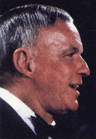 It was only natural that I read Barbara Sinatra’s memoir, Lady Blue Eyes, published recently. How could I not? After all, I had spent four years researching and writing a biography of her husband in 1986: His Way: The Unauthorized Biography of Frank Sinatra.
The book became number one on the New York Times best seller list and sold over 1 million copies in hardback, but the subject sued me before I ever wrote a word, saying that he and he alone or someone that he authorized was entitled to write his life story. He dropped his lawsuit after a year, but by then he had effectively put the world on notice that he did not want the book written by someone who was not in his control.
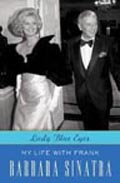 Mrs. Sinatra writes in her memoir that Frank despised the press with the sole exception of former TV host Larry King, novelist Pete Hamill, and the late James Bacon, who wrote a Hollywood column for the Los Angeles Herald-Examiner. No surprise there as each man genuflected to “Ole Blue Eyes.” And there was much to admire in the man—his monumental talent, great showmanship and unparalleled philanthropy. But there was also a dark side, violent and frightening.
In researching His Way, I traveled to Hoboken, Manhattan, Hollywood, Las Vegas and Palm Springs to interview Sinatra’s relatives, friends, employees, co-stars, musicians, business associates, directors, producers, and former lovers, most of whom spoke on the record. Yes, there was a long line of women—show girls, call girls, movie stars, manicurists, even the wives of some of his best friends. But aside from his own wives, most of Sinatra’s women were simply there to help him make it through the night.
An exception was Nancy Gundersen, who I knew had played an important part in his life for several years before she became the wife of New York ob-gyn Martin L. Stone, M.D. Ms. Gundersen declined to be interviewed when I called her years ago. So I was surprised a few months ago when she approached me after a speech I had given for the College of the Desert in Rancho Mirage. “It’s been almost 25 years since you called,” she said, “but you can have that interview now, if you’d like.”
We both laughed, made a date for lunch the following week and spent hours comparing notes on the Frank she knew and the Frank I wrote about. Elegant, pretty, and whip smart, she was delightful, and I saw immediately why Sinatra had been so charmed.
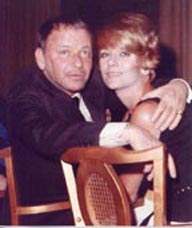
“Frank and I met on a blind date in New York in 1970 when I was the house model for Anne Klein,” she said. “I had had been working on an M.A. in International Relations at the New School before that. He was 23 years older than me but we clicked immediately…. On our first date He gave me his antique Dunhill lighter. Anne wanted me to look great every time I went out with Frank so once she loaned me a gorgeous mink coat. Frank loved the coat and complimented me on it but I told him the truth–that it wasn’t mine, that I had borrowed it for the evening. The next day I found an envelope filled with $100 bills and a note that said: ‘Buy your own mink coat.’ So I did.
“Anne Klein loved our affair and always dressed me when Frank and I went out. One night Frank asked me to go to the theater with Loel and Gloria Guinness. I was too young to know that Gloria Guinness was a renowned beauty and supposedly the most elegant woman in the world but Anne knew what I was up against so she dressed me in a gorgeous white silk dress, cut on the bias, topped by a spectacular orange silk patch work coat that Frank just loved because, as you know, orange was his favorite color.”
Nancy Gundersen Stone recollected sweet times with Sinatra. “We had a wonderful affair for two years that melted into a deep friendship for another two years… I loved Frank, but was never in love with him… I spent many, many week-ends at his house in Palm Springs and I have to laugh as I remember the deep freeze I’d always get from Dinah Shore and the girls who were pushing him to marry Barbara Marx…. He told me Ava had been the great love of his life and that that love almost ruined him. He never got over her—ever.”
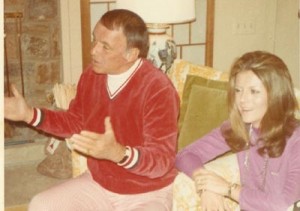
Blessed by good looks, a good education and Anne Klein, Nancy had the cachet (or “class” as Frank Sinatra said) to travel easily in all of his worlds. He flew her to Las Vegas for his shows and to weekend with him at publisher Bennett Cerf’s house in Westchester County. “I was not a show girl,” she said, “so he felt he could introduce me to all sorts of people.”
She also accompanied him to his mother’s house in New Jersey when he signed his record contract. She remembered Dolly Sinatra as “rawhide tough,” but adored by her son. “That night Frank wrote a check for her for $1 million.”
Barbara Sinatra writes in her memoir that Frank never discussed his finances with her. Yet he seems to have shared many such details with Nancy Gundersen. “When he drew up the trust funds for his kids he made sure that Frank, Jr. got his payout at the age of 21 but the girls, Nancy and Tina, could not get their money until they were 35. ‘Otherwise, they’ll marry bums,’ Frank said.”
Nancy Gundersen came to know Frank’s daughters very well, having spent so much time with them at his house in Palm Springs. “One night Frank was receiving an award at Chandler Center and he escorted Nancy Sr. and his daughters. I was driven to the ceremony by Sarge Weiss. It was a bit uncomfortable, especially when Nancy, Jr. pretended not to know me in front of her mother, but Tina, who is like her father, ran over to give me a big hug. Frank and I left right after for Palm Springs.”
Interesting to note that after 22 years of marriage to their father, Barbara Sinatra does not mention either of his daughters in her memoir. Since Frank Sinatra died in 1998, the three women have not spoken, except through lawyers. Their fights are primarily over money, although each was magnificently taken care of in Sinatra’s will. The two daughters have written books suggesting that the blond Las Vegas show girl who became their step-mother was not worthy of their father’s iconic name.
Nancy and Tina Sinatra, both of whom have been married and divorced never took their husbands’ names, preferring instead to go through life as Frank Sinatra’s daughters. And who could fault them? In its day, the Sinatra name could open any door. As Barbara Sinatra writes, she met presidents, prime ministers and potentates. She details the delights of being Lady Blue Eyes (the mansions, the mammoth jewels, the private planes, the famous friends) and the dangers (the violent fights, the black moods, the uncontrollable temper). She also dishes.
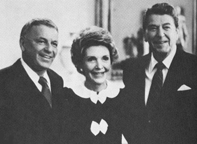 She dismisses former First Lady Nancy Reagan as a user. “[She] was never a close friend, and it had nothing to do with the fact that she seemed to have a crush on my husband…. I felt she took advantage of Frank’s huge heart…. During long distance telephone calls and their lunches together whenever they were in the same town, I think Frank became Nancy’s therapist more than her friend.”
After telling readers that her husband, “Charlie Neat,” was obsessively clean, took three showers a day and allotted $1 million a year to himself to lose at gambling, Barbara Sinatra writes that as his wife it was her job to vet the guest list of every party to which they were invited. If there was a guest that Frank did not like, Frank did not attend. When Henry Kissinger planned a dinner in Frank’s honor, he had to submit the guest list to Barbara. Unfortunately, for Kissinger, he had invited Barbara Walters, whom Sinatra detested, so Sinatra refused to go to the party. Stunned, Kissinger called Barbara Sinatra three times, begging her to get her husband to reconsider, but Sinatra was adamant. Mrs. Sinatra told the former Secretary of State that her husband would not go anywhere Barbara Walters was present. Finally, Kissinger had no choice but to disinvite Walters. Only then would Frank Sinatra agree to attend the party in his honor.
Right, wrong or rude, the man certainly did it His Way.

Photo credits: Nancy Gundersen with Frank Sinatra, courtesy of Nancy Gundersen Stone; Frank Sinatra 1986, Frank Sinatra with the Reagans in 1985, and the author in 1986 used with permission of the Estate of Stanley Tretick.
Cross-posted from Huffington Post
Happy Birthday, Nancy Reagan
by Kitty Kelley
My heartiest congratulations to Nancy Reagan today [July 6, 2011] as she celebrates her 90th birthday. You might think I would be (or should be) the last person to offer such a salute to the former First Lady. After all, I never voted for her husband, or supported any of his policies. To the contrary, I incensed him no end a few years ago when I wrote Nancy Reagan: The Unauthorized Biography.
Still, I salute longevity, and I applaud the fortitude of Mrs. Reagan to soldier on, despite her battles with breast cancer, a broken pelvis, and painful arthritis, plus the death of her beloved husband after a wrenching slide into Alzheimer’s. My father, who voted for Ronald Reagan every chance he got, lived to be 98 years old and showed me the tensile strength it takes to reach a venerable age. It’s no small accomplishment. Bette Davis was right: Old age is not for sissies.
Momentum is difficult without the buoyancy of youth; high hopes diminish with sickness and disease, and the optimism to forge ahead wilts with the loss of loved ones. Few people have the guts, the good luck and the genes to live long and productive lives. Since most of us won’t reach the age of ninety I think such a birthday is an occasion to celebrate. So I commend Nancy Reagan, and fully expect her to break the tape at 100 as Willard Scott hoists a Smuckers jar in her honor.
At the time I wrote Mrs. Reagan’s biography in 1991 she was still shaving her age by a couple of years, a harmless vanity for a former starlet. When she turned 69, reporters asked how old she was, and she coyly replied: “I still haven’t made up my mind.” They had to ask because they did not have access to her birth certificate. The document had been placed under court seal years ago in Chicago following Nancy’s adoption by her step-father Loyal Davis.
Once I was able to obtain a copy of that birth certificate I saw the formidable force that was to become Nancy Reagan. By then only two entries remained accurate: her sex and her color. Everything else had been rewritten like a Hollywood script. Born Anne Frances Robbins on July 6, 1921, she changed her name, revised her date of birth, concealed her roots (Amity Street in Flushing, New York near the railroad tracks) and replaced her father, Kenneth S. Robbins, a salesman from Pittsfield, Massachusetts, with the prominent surgeon, Loyal Davis, her mother’s second husband.
Nancy was thirty years old when she married Ronald Reagan, and, as she said, “That’s when my life started.” Few historians would disagree that “Mommy,” as her husband called her, was the moving force behind his success. Without her, he would never have become President. During the White House years she soldiered him through everything from the assassination attempt to the scandal of Iran Contra. Behind the scenes she hired and fired his advisors, dictated to his staff and his cabinet, even tempered his foreign policy. Yes, she consulted astrologers, “borrowed” designer clothes, and was besotted by Hollywood glitz and glamour. But something splendid happened after she left the White House and her husband received his tragic diagnosis. She came out of the shadows to become an activist.
 Performing her best public service, Nancy Reagan began campaigning for expanded stem cell research. In 2004 she put herself at odds with her party by opposing President George W. Bush’s restrictive policies, which limited federal funding to stem cell colonies created before August 2001. She then joined Michael J. Fox and helped raise $2 million for stem cell research into Parkinson’s and Alzheimer’s. In 2006 she lobbied members of congress to revive a bill to expand federal funding. In 2007, at the age of 86, looking frail but sounding firm, she continued speaking out. “There are so many diseases that can be cured or at least helped,” she said. “We have lost so much time already and I just really can’t bear to lose anymore.” In 2009 she praised President Obama for overturning the Bush policy. “We owe it to ourselves and our children to do everything in our power to find cures for these diseases.”
So I raise a glass to Nancy Reagan as she celebrates her 90th birthday and salute her for showing us how to play the last inning with style.
Cross-posted from wowOwow
Oprah Winner, International Book Awards
by admin
 The results of the 2011 International Book Awards have been announced.
Oprah: A Biography has been honored as a “Winner” in the “Biography: General”
category.
Oprah is available as a paperback published by Three Rivers Press, and as an ebook.
See reviews of Oprah here.

ELIZABETH TAYLOR released as eBook
by admin

Kitty Kelley’s Elizabeth Taylor: The Last Star has been updated with a new chapter and released as an eBook by Simon & Schuster.
ELIZABETH TAYLOR: The Last Star
By Kitty Kelley
Published by Simon & Schuster
Price: $9.99
ISBN-13: 9781451656473
Format: eBook, 448 pages
Read the press release here.
“Bawdy, sincere, irreverent…an epic of vitality and appetite.” —New York Times Book Review
“Dazzling and irresistible.” —Publishers Weekly
“Brash, naughty and vividly entertaining…the ultimate movie-star biography…mesmerizing.” –Cosmopolitan
“Gossipy, bitchy, fact-filled.” —San Francisco Examiner
“A meticulously researched and properly lurid account.” —Los Angeles Times
Author’s proceeds will be donated to The Foundation for AIDs Research (amfAR) in tribute to Elizabeth Taylor’s fight for a cure for AIDS.
UPDATE, 5/2/11:
Also available as a trade paperback.
Buy: Amazon Apple Barnes & Noble
"Oprah Fired Me for Talking About Jesus"
by Kitty Kelley
Shortly after Oprah Winfrey became a national sensation she hired her first cousin Jo Baldwin to be her speech writer. Later she promoted Baldwin to V. P. of her company Harpo Inc.

“When I received my PhD in 1985 from the University of Wisconsin-Milwaukee, Oprah asked me where I was going to work,” said Jo Baldwin in the summer of 2010. “I said I would be applying for a position at Ebony magazine as a copy editor. Oprah said she did not like Linda Johnson Rice [owner of Ebony] and I should come to work for her instead. So I did.
“I was to work for her for three years, but she fired me without notice after two years… I heard from someone later that she got rid of me because she got tired of me talking about Jesus all the time…Oprah preferred the teachings of Shirley MacLaine’s books, such as Dancing in the Light and Out on a Limb, which Oprah made me read but I didn’t think much of.”
Jo Baldwin, a tenured professor at Mississippi Valley State, is also an ordained minister and pastor. Deeply religious, the Reverend Jo, as her parishioners call her, feels her famous cousin has lost her way and is mired in godless New Age mumbo jumbo.
Baldwin’s feelings, like many in Oprah’s family, stem from resentment over the way she has been treated. The power of Oprah’s vast wealth makes most of her relatives quake. They want to be part of the luxurious life that she offers on occasion (her lavish Christmas presents, her birthday checks, even her hand-me-downs) but they chafe at the way she has dismissed them since becoming famous and they know that she does not cherish them as family. She prefers instead her celebrity friends. Oprah holds Maya Angelou as the mother she should’ve had; she sees Sidney Portier as her father, Quincy Jones as her uncle, and Gayle King as her beloved sister.
Jo Baldwin became estranged from her famous relative who continues to put distance between herself and her blood relations. Oprah will not give her mother, Vernita Lee, her personal phone number. If her mother needs to call Oprah, she must call the studio and talk to Oprah’s producers.
“The family is tangled with so many secrets and so much fear,” said Baldwin. “I admit I was afraid of Oprah for 20 years. Absolutely terrified. She’s powerful and dangerous. She told me if I ever opened my mouth [about what I know] she’d sue my pants off.”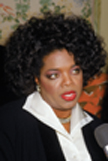
Baldwin, who spoke to me for the paperback publication of Oprah: A Biography, feels the main reason she is not close to Oprah is because of the differences in their religious convictions.
“Mainly, Oprah wanted to shame me for being a follower of Jesus as if to say, ‘What is He doing for you that’s so great?’ Oprah inflicts emotional wounds that could lead to physical illness, if they aren’t healed. My faith has kept me from getting sick [over her].”
(Photos: Jo Baldwin courtesy of Jo Baldwin; Oprah in 1987, Kevin Winter/Time & Life Pictures/Getty Images)
Cross-posted from Gawker
Another Oprah Lover Heard From
by Kitty Kelley
It always happens. The day after your book is published you meet someone who says, “Oh, I wish I’d known you were writing that biography. I could’ve told you about ….” Fill in the blanks here with some hair-raising incident you did not have in your book, despite years of research and hundreds of interviews. Never fails.
Shortly after the paperback publication of Oprah: A Biography, I received an email from a man, gently chiding me for my vaunted investigative skills. “How come you didn’t find me?” he teased. “I was Oprah’s lover back in the 1980’s and lived with her for four months before Stedman came on the scene.”
Ordinarily, such an email would be tossed into the crank bin filled with letters from felons, proclaiming their innocence. But this particular email had too many specifics to ignore. So I responded with pertinent questions to see if this Haitian film maker, Reginald Chevalier, was the real deal. Turns out he was. I called Oprah’s publicist to double-check his information but my call was not returned.
Not that I needed to add any more lovers to Oprah: A Biography. She had had several over the years, including the muzak musician John Tesh, when they worked together in Nashville, and retired radio disc jockey Tim Watts, the married man who was the love of her life for years in Baltimore. There was also a brief fling with Randy Cook, who lived with Oprah for a few months and described himself as her drug procurer.
Reginald Chevalier said he met Oprah when he appeared on her show in 1985. “She was doing a segment on look-alikes and at the time I looked like Billy Dee Williams. She later confided that she instructed her producers to keep me backstage after the show. She threatened to fire them, if I got away. She took me to lunch at the Water Tower restaurant and ordered stuffed mashed potatoes for both of us.”
Their affair began that day.
I remember how she loved taking candle-lit baths before going to bed. We took lots of them together. We spent many nights together in her new condo which she loved so much. I would be watching TV and she would be working on her next day’s show…. Besides going to restaurants for lunches and dinners, to stores to buy gifts for employees and friends—Oprah is generous with stuff—we would go to the Bears games because I was friends with one of the players. We occasionally had dinner with Michael Jordan and his wife, Juanita, or with Danny Glover, [Oprah’s co-star in The Color Purple.]
I noticed a few times she would bring up the subject of marriage and ask me if this was something I believed in. I think at that time Oprah was ready to take the plunge, and I was the chosen one…but I wasn’t interested in getting serious…. Oprah took me to her mother’s house for dinner in Milwaukee and that’s where I met Jeffrey, her gay brother [who died of AIDS in 1989]. Oprah said to him, “You stay away from this guy. He’s mine.”
Chevalier was 25 years old then and Oprah was 32, but he said the age difference didn’t matter to either of them. He accompanied Oprah to the Chicago premiere of The Color Purple. “Oprah bought a purple mink coat for the occasion and wanted me to wear purple mink as well but I just couldn’t do it.” Their photo appeared in the Chicago newspapers. “If you look carefully, you can see part of Gayle King’s face in the lower left of the picture,” he said. “Gayle was always around. Everywhere we went she was there. She was Oprah’s shadow.”

Chevalier has fond recollections of his time with Oprah, although he admits that she’s a much more reserved, calculating person off-camera than the warm, embracing person she presents on her show. “Things came crashing to a halt in April 1986,” he recalled. “I had been out of town on a modeling assignment and when I returned to the Water Tower condo, my key wouldn’t work. The concierge informed me that the locks had been changed. Oprah had left a box for me filled with all my belongings. On a yellow envelope she had written: ‘Sorry, things aren’t working between us. Oprah Winfrey.’ That was it. No phone call. No good-bye. Nothing. She was as cold as ice…. A few weeks later Stedman was on the scene— full time.”
 Reginald Chevalier then.
Reginald Chevalier now.
(Photos courtesy of Reginald Chevalier.)
Cross-posted from Gawker
Writing Oprah: A Biography
by Kitty Kelley
In researching Oprah: A Biography I spent several days in Kosciusko, Mississippi where Oprah Winfrey was born and lived until she was six years old. I spent time with Katharine Carr Esters, Oprah’s first cousin, whom she calls “Aunt Katharine.” Mrs. Esters, 79 at the time, was my guide to the formative years of Oprah’s life in Mississippi and later with her mother in Milwaukee where Mrs. Esters said, “Oprah ran wild on the streets.”
During our days together Mrs. Esters talked about the strained relationship between Oprah, her mother, and the man who had fathered Oprah. “It’s not Vernon Winfrey,” said Mrs. Esters, “although he’s the one who stepped forward to take responsibility of her when Oprah needed it most.”
Mrs. Esters told me the name of Oprah’s real father but insisted I not publish the information until Oprah’s mother told Oprah the truth. When my book was published in April 2010 Mrs. Esters, obviously feeling the pressure from her powerful relative, backed away and denied what she had told me.
A few months later I received a call from Mrs. Esters’ daughter, Jo A. Baldwin, who had once worked for Oprah in Chicago as V.P. of Harpo. I had tried to interview Baldwin at the time but she would not talk. “I was too scared of Oprah,” she said. “Oprah told me if I ever talked she’d ruin me…. But I can talk to you now.”
“Why now and not then?” I asked.
“Because I now have tenure and Oprah can’t take my job away from me.”
Jo Baldwin is associate professor of English and director of the Writing Center at Mississippi Valley State University and pastor of Greater Disney Chapel African Methodist Episcopal (AME) Church in Greenville, MS. Her friends call her Rev. Jo.
“I know now that you wrote the truth when you wrote about mom telling you the name of Oprah’s real father,” she said. “My son, Conrad, [who lives with Mrs. Esters], told me he heard mom say it.” Jo Baldwin agreed that when my interviews with her mother became public, Mrs. Esters became afraid of what Oprah might do to her, and backed away from what she had told me.
Over a period of weeks Rev. Jo and I spoke on the phone several times and exchanged numerous emails. I’ve included much of her information in the paperback of Oprah: A Biography (published January 18, 2011) but the story below is one she sent me after the paperback had gone to press.
WHY I TALKED TO KITTY KELLEY ABOUT MY COUSIN OPRAH
by Jo A. Baldwin
Over 20 years ago I found out people won’t believe you if they don’t want to. They won’t even hear what you have to say in the first place. But now almost 25 years later someone was interested in hearing about my two-year stint working for my cousin Oprah and that person is Kitty Kelley. From 1986 to 88 I was Oprah’s Vice President of Development at Harpo and most of what I had to say about her is in Miss Kelley’s paperback. But I recently remembered one story that I had buried because it was so painful and decided to share it in this blog.
When I started working for Oprah she only paid me $1200 a month—that’s $14,400 a year—because that’s what I told her to pay me based on what my mother had said about my being a fool if I thought she would let me fly as high as I could (see the paperback for more details). Before hiring me she asked me about my debts—I didn’t have any at the time—and she asked me if I had any assets. That’s when I told her about my Tiffany lamp. She asked me if she could buy it but I told her no that it was my inheritance from Mother Carr and I was going to keep it. (My grandmother and her grandmother were sisters.)
Years ago my maternal grandmother was a live-in cook and nurse for a bachelor and his two spinster sisters who had fled the Holocaust and lived in Milwaukee. I won’t say their names or what he did for a living, but he was wealthy, and Mother Carr took care of them until he died. He left her many things that some of his nieces and nephews didn’t want her to have but because he was in his right mind when he gave them to her there was nothing they could do about it. One of the items was a signed Tiffany lamp and base.
Before Mother Carr died she told my mother in my presence that she wanted me to have the Tiffany, so when she passed my mother gave it to me along with a platinum and diamond watch that I think came from Tiffany’s too although I didn’t have it appraised like I did the lamp. One appraiser said the lamp was worth $65,000 and one said $24,000, so I decided to put it in a safety deposit box at the bank because the first appraiser said it was just a matter of time before somebody stole it. It was in the bank over ten years before I had to sell it, which is where Oprah comes in.
The first year I worked for her was exciting. I traveled with her, wrote the core of her speeches because she was best when improvising, and advised her on what to say and not say. She listened to me but ended up doing what she wanted most of the time. I got a lot of exposure, which she didn’t like, so the second year she practically ended my traveling with her and doing things in her office in Chicago. The second year I mainly worked out of my house in Milwaukee.
She had given me a mink coat and Stedman’s old Mercedes I thought as gifts, but I found out she had counted them as cash income and that she wasn’t paying my taxes but that I was supposed to take the taxes out of the $1200 a month. So I asked her for a raise to pay the taxes but she said she wasn’t giving anybody a raise that year. That’s when I learned another valuable lesson. When you’re naïve after a certain age, you get punished for it. Shortly after that she fired me with no notice sending me a check for $5,000 severance pay. I used the money to relocate because she had already started having parties and celebrations in Milwaukee and inviting everybody but me, so I moved out of state.
Well, the IRS caught up with me and said I owed $9,000 in back taxes from working for Oprah. I had a job that paid enough to take care of my monthly bills, but I didn’t have that much money so I asked my mother to help me. She said she didn’t have it either. I told her they knew about my lamp and that I didn’t want to lose it, but she said sell it because that’s what an inheritance is for. So I got an antique dealer to put it in an auction and it sold for $16,500. I paid the taxes, but it took me years to get over hearing about how she gives millions of dollars away to people she doesn’t even know and wouldn’t give me a raise for the work I did for her so I wouldn’t have to sell my lamp.
To this day I don’t know how she found out I no longer have the lamp, but in a conversation I had with her about my novel—that she lied and said she never read—she had the nerve to say I was just upset with her about losing the Tiffany.
If she only knew what I know, she’d do differently.

Jo A. Baldwin has a B.A. in English from the University of Wisconsin-Milwaukee (UWM), a M.A. in Creative Writing from UWM, a M.A. in Speech Theatre from Marquette University, Milwaukee, Wisconsin, a Ph.D. in English from UWM, and a Master of Divinity from United Theological Seminary, Dayton Ohio. Baldwin is the first black American to earn a Ph.D. in English from UWM. She is an Associate Professor of English and Director of the Writing Center at Mississippi Valley State University, Itta Bena, Mississippi, and the first in the country to modify Shurley English for college students, a method for teaching Basic English grammar that she revolutionized with her own poems and songs. Her REFERENCE MANUAL FOR Shurley English MODIFIED FOR COLLEGE STUDENTS will be available pending obtaining a trademark on her intellectual property. She is the Pastor of Greater Disney Chapel African Methodist Episcopal (AME) Church, Greenville, Mississippi, and the first to author a book on “Tuning” which is a form of Preaching in the Black Tradition entitled Seven Signature Sermons by a Tuning Woman Preacher of the Gospel published by the Edwin Mellen Press, “An International Scholarly Publisher of Advanced Research.”
Oprah: A Biography Paperback
by admin
Oprah: A Biography, with new material, released as a paperback on January, 18, 2011.

Three Rivers Press
ISBN 978-0307394873
#1 New York Times Bestseller
Read the press release here.
Read reviews and coverage of Oprah: A Biography here.
Buy: Amazon Apple Barnes & Noble
Frank Sinatra and Me
by Kitty Kelley
I can’t say I wasn’t warned. Alarms started clanging the day I signed to write His Way: The Unauthorized Biography of Frank Sinatra (Bantam Books, 1986).
Some friends urged me to buy life insurance and make them the beneficiaries; others recommended bodyguards and a bullet-proof vest. The rumors of Frank Sinatra’s violence and his ties to organized crime were such that journalists joked in print about me ending up in concrete boots and sleeping with the fishes, if I proceeded to write his biography. Milton Berle joshed at the Friars Club, “Kitty Kelley wanted to be here tonight but an hour ago she tried to start her car.”
The laughs stopped when I received a message on my answering machine: “Soy-ving by Oy-ving here. Call ASAP ‘cuz we gotta soyve ya.”
I figured it was a New Jersey caterer who had the wrong number. Turns out it was a process server named Irving in the subpoena business of serving.
“Serving by Irving” was no joke. Frank Sinatra was suing me before I had written a word. In fact, the book was five years away from publication, but Sinatra wanted to make sure it would never be published. So he sued me (not my publisher) in Santa Monica, California, seeking $2 million in punitive damages, saying that he and he alone, or someone that he anointed could write his life story. Anyone else would have to pay $2 million dollars for daring to undertake the enterprise.
Getting sued by one of the most powerful men in the country—and one with mob connections—gets your attention. Fortunately, a national coalition of writers groups rose up to protest, claiming that Sinatra’s lawsuit against me was an assault upon all writers’ constitutionally protected freedoms of expression and should be dismissed on its face. In a joint statement they said: “The apparent goal behind Sinatra’s filing of this suit is to scare Ms. Kelley away from her investigation and, ultimately, to force her to scrap the book. Abuses of the judicial system such as these pose a serious threat to all writers.”
For one year, Sinatra pursued his lawsuit, but his allegations proved groundless, and he finally was forced to drop his case.
The writers groups applauded his action. “The court’s dismissal of this meritless suit—at the request of Mr. Sinatra—is a victory for all writers and the public,” stated their press release. “It reaffirms the right of the public to be informed about the lives of influential public persons whether or not they approve of the writer and his or her approach.”
The Baltimore Sun editorialized on the right to cover public figures without restriction: “If all the public can learn of the person is what the person himself wants it to learn, then our will become a very closed and ignorant society, unable to correct its ills, quite unlike what the drafters and subsequent generations of defenders of the free-speech First Amendment had in mind.”
I continued my work, interviewing Sinatra’s friends, employees, associates, former girl friends and lovers, federal law enforcement agents, plus musicians, movie stars and mobsters like Moe Dalitz, who had known and worked with him over the years. I also interviewed a few Sinatra relatives, including his son, Frank Sinatra, Jr. Through my years of research I received regular calls from Liz Smith, former New York Daily News gossip columnist, with all sorts of Sinatra stories, mostly scurrilous. Yet a few weeks before publication, Sinatra decided to make amends with the woman he demeaned on stage as “a dumpy, fat, ugly broad,” and referred to as “Lez” Smith. He invited her for drinks, she swooned, and Sinatra never had to read another negative word about himself in her columns.
My book was published in 1986 and enjoyed great success, selling over 1 million copies in hardback—a testament to the enduring fascination with Frank Sinatra. However, His Way was not applauded by the singer or his family, for the biography had opened doors that they had long kept locked.
Upon publication Nancy and Tina Sinatra called reporters to denounce the book and its author. Their father railed on television about “pimps and prostitutes” who write “a lot of crap” for money. “We nearly strangled on our pain and anger,” Nancy Sinatra said, reviling me as “the big C-word… I hate [Kitty Kelley]… If I ever met her, I don’t know what I’d do….” She ranted for months on her website and was still ranting years later when she tried to jump-start her career at the age of 54 by posing nude for Playboy. “Don’t ask me any questions about that goddamned Kitty Kelley or her goddamned book,” she warned reporters.
Tina Sinatra claimed that my biography had made her father ill, causing him to undergo major colon surgery in 1986 for seven and a half hours, and to endure a temporary colostomy. Tellingly, she waited until her father had died before she published her own book, which lacerated Barbara Sinatra, her father’s wife of 22 years, as a grasping, gold-digging wench not worthy of the family name. To this day the women speak only through lawyers.
Now that His Way: The Unauthorized Biography of Frank Sinatra is being published in trade paperback the alarms are once again clanging. “Take cover. Prepare for incoming,” warned one friend via e-mail. “Ole Blue Eyes might be gone but his daughters still prowl the forest.”
There is no longer any question about Frank Sinatra’s ties to the Mafia. As if to tease those mob connections, Nancy and Frank Sinatra, Jr. each appeared in different episodes of HBO’s The Sopranos. The producers of the hit series hung Frank Sinatra’s mug shot in Tony Soprano’s office at the Bada Bing. Yes, Ole Blue Eyes was once arrested on a morals charge and jailed for three days. (See pages 7-9 of His Way.) Movie directors continue to license his music as melodic striptease for their gangster films, and his picture inevitably appears in any film about the mafia.
My biography of Frank Sinatra is not paean to his music but rather an illumination of the man behind the music, who once described himself as “an 18-karat manic-depressive who lived a life of violent emotional contradictions with an over-acute capacity for sadness as well as happiness.”
Taking the man at his word I rode the roller coaster, and now a new generation of readers can join me for the ride.

Photo: Kitty Kelley interviewing Frank Sinatra Jr. on January 15, 1983 in his suite at the Hyatt Regency Washington in Washington DC for His Way: The Unauthorized Biography of Frank Sinatra.
Cross-posted from Huffington Post
HIS WAY new edition, December 28, 2010
by admin
Kitty Kelley’s groundbreaking His Way: The Unauthorized Biography of Frank Sinatra has been updated and released in a trade paperback.
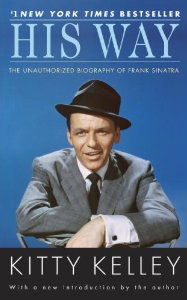
#1 New York Times Bestseller
Also available as an ebook.
More on His Way here and here.
Update December 30, 2015: The 2010 Introduction bu Kitty Kelley was published in the New York Social Diary with a personal note by David Patrick Columbia, here.