
Book Review
Rose Kennedy: The Life and Times of a Political Matriarch
by Kitty Kelley
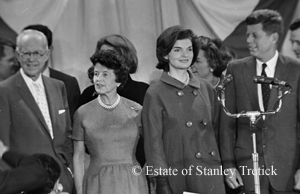 Anyone who has followed the Kennedys knows the bar is high for books on the subject. Having been inundated for the past 50 years with hundreds of biographies and memoirs and profiles about the spellbinding mystique of John Fitzgerald Kennedy, his family and his thousand days as the country’s first Irish-Catholic president, we expect each publication to bring something new and fresh to add to our understanding of the family that refashioned politics in the 20th century.
Serious historians (Arthur Schlesinger, Jr., William Manchester, James MacGregor Burns, Nigel Hamilton), journalists (Seymour Hersh, Jack Newfield, Warren Rogers), conspiracy theorists (Jim Garrison), commercial clip-and-pasters (Laurence Leamer, Christopher Anderson) and friends (Paul “Red” Fay, Benjamin C. Bradlee) have tried to capture the firefly magic of the Kennedys, while antagonists (Victor Lasky, Ralph de Taledano) have tried to puncture their myth.
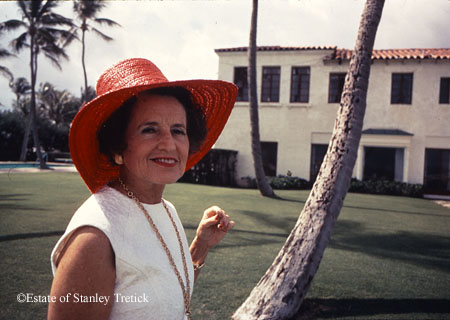
So now comes Barbara A. Perry with Rose Kennedy: The Life and Times of a Political Matriarch, who promises to deliver “the definitive biography” of the woman whose iron-fisted image-making produced the mystique that continues to endure. When the John F. Kennedy Library released the papers of the president’s mother (300 boxes) in 2006, Perry, a senior fellow in presidential oral history at the University of Virginia’s Miller Center in Charlottesville, was first in line, but, alas, Rose had no secrets beyond the few she revealed in her 1974 memoir, Times to Remember. As a biographer Perry was challenged. After six years of research and writing, she bowed to the obvious: With nothing new, she went for nuance. Her text is well written and her bibliography shows research, but there is no gold in the mine.
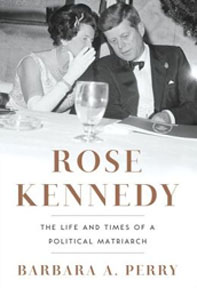 Her book cover, though, is perfect, absolutely perfect, because it captures the essence of Rose Fitzgerald Kennedy. The black-and-white photograph shows a woman who later died at the age of 104 after living her life by the black-and-white strictures of the Catholic Church, pre-Vatican II. Still glamorous at the age of 73, she is sitting next to the handsome president at a White House state dinner in 1963. She is acting as her son’s hostess because the first lady is away on one of her many vacations, similar to the ones Rose took for six to eight weeks at a time to get away from the clamor of her large family, and possibly, according to her biographer, as a means of Church-approved birth control. Rose is wearing the Molyneux gown she wore when she was 48 and her husband, Joseph P. Kennedy, was presented to the king and queen of England as the U.S. ambassador to the Court of St. James. That was the crowning glory of Rose’s life: To be accepted by British royalty was beyond the biggest dreams of a little girl from Dorchester, Mass.
Bejeweled with two diamond clips in her hair, diamonds dripping from her ears, a triple strand of pearls the size of grapes circling her unlined neck and a bracelet of diamonds wrapped around her arm, which is encased in a long white kid-leather glove, Rose is whispering in her son’s ear. 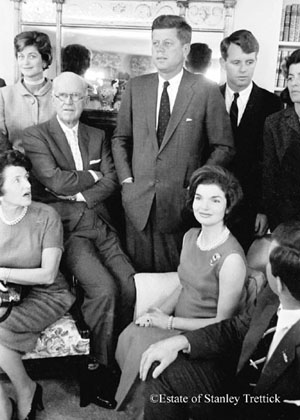 Ever the canny pol, she covers her mouth so the photographer cannot catch a candid shot. (“I do not like candid pictures,” she said. “They are so unattractive.”)
Oh, did I mention that the Molyneux gown was sleeveless? This is a detail Rose would want to have emphasized because she prided herself on her petite figure and frequently said that after having nine children she could still wear a size 8. Her frenetic exercise routine of swimming in the ocean every day, playing golf, walking miles, eating sparingly and rarely drinking had left her sleek and svelte with tanned, taut arms.
Appearances ruled Rose, and nothing mattered to her as much as how one looked — in person and in pictures. She made her children line up for daily inspections so she could see if their shoes were shined and their buttons attached. She saw each child as a reflection of herself and of the family name her husband was making famous on Wall Street and in Hollywood, so she strove for perfection, demanding it of herself and everyone around her. A martinet mother, she insisted her children brush their teeth three times a day and say their prayers every night. They were instructed to make meals on time or go without eating, and en route to the dining room they were required to check the bulletin board for the topics of current affairs that were to be discussed at dinner. Rose was the parent in charge of their childhood. When they became young adults her husband took over, but as one daughter said, “Dad gave us many lovely things but mother gave us our character.”
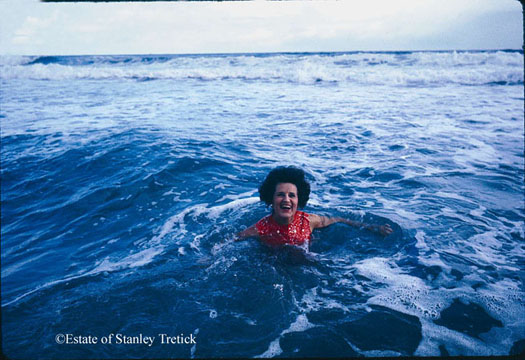
Despite her foibles and her husband’s philandering Rose relied on her strong religious faith to survive the worst tragedies of her life, and she managed to produce an extraordinary family of sons and daughters, who cared for each other, supported each other and remained close throughout their lives — and that is a mother’s finest legacy. Rose Fitzgerald Kennedy is an admirable subject but one that left her admiring biographer empty-handed.
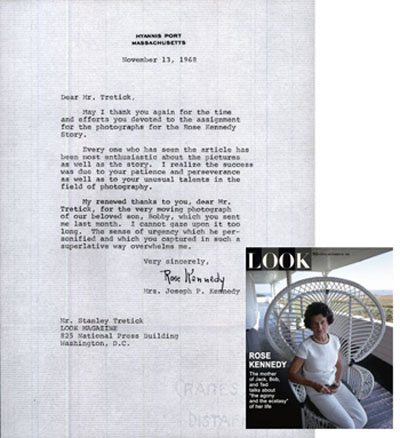 Kitty Kelley’s seven biographies include Jackie Oh! (1978), the first book to reveal that the former first lady suffered from depression and was treated with electroshock therapy; it also reported for the first time that Rosemary Kennedy survived the mangled lobotomy her father had ordered in hopes of reversing her mental retardation. In 1988, People published Kelley’s story detailing President Kennedy’s affair with a woman who carried his messages to her other lover, mobster Sam Giancana.
Cross-posted with Washington Independent Review of Books.
Photos from Capturing Camelot ©Estate of Stanley Tretick, used with permission.
The Patriarch
by Kitty Kelley
 The Patriarch (Penguin Press) is the perfect title for the life story of Joseph Patrick Kennedy. It resounds with the drama of rolling drums to introduce a paterfamilias who created one of America’s most powerful political dynasties. The author, David Nasaw, was hand-picked by the Kennedys and given access to all the family’s personal papers, including the senior Kennedy’s letters, which comprise the ballast of this biography.
Such access is no surprise for an historian on the faculty of the Graduate Center of the City University of New York, where he is the Arthur M. Schlesinger Jr. Distinguished Professor of American History. As President Kennedy’s in-house historian and the devoted biographer of Robert F. Kennedy, Schlesinger was no incidental contributor to the myths of Camelot, but this is not to say that Nasaw’s biography is hagiography. He covers the light as well as the dark corners of Joseph P. Kennedy’s complicated persona. But having written biographies of William Randolph Hearst and Andrew Carnegie, Nasaw prefers to describe himself “as an academic historian, not a biographer,” which may be why his narrative reads like an orange squeezed dry. For 896 pages he follows the chronology of Joseph P. Kennedy’s life (1888-1969) as methodically as a metronome, and documents all the facts with footnotes. Yet one wishes there had been a little more poet in the professor.
Joseph Patrick Kennedy was born to all the prosperity that East Boston allowed Irish-Catholics in the 19th-century, which was fathoms below the social acceptance accorded “proper Bostonians,” as Kennedy referred to his Protestant peers. Blessed with charm and intelligence, he was determined to break down the wall that separated former “bog-dwellers” from their Brahmin “betters.” This became his life’s ambition and drove him to make his son the country’s first Irish-Catholic president.
After attending Boston Latin, then the best public school in the country, young Joe was accepted at Harvard. There he excelled in athletics and networking, which, he impressed upon his sons in frequent letters, was the purpose of Harvard. “You will have a great start on any of your contemporaries and you should be able to keep up very important contacts,” he wrote. Befriending “the topmost people,” as he called them, became a lifetime priority.
After graduating from Harvard, Kennedy was unable to get a white-shoe job on Wall Street, so he became a bank examiner in Massachusetts and mastered the intricacies of an unregulated stock market, eventually earning a reputation as a “rapacious plunger.” He pounced on bankruptcies, foreclosures and receiverships, and used insider knowledge to buy and sell stock, all of which would later become illegal. As president of an East Boston bank he borrowed heavily from the bank to finance his trades, and borrowed even more to invest in commercial real estate. In 1945 he bought the Merchandise Mart in Chicago for $13 million. The family sold the Mart in 1998 for $630 million.
Kennedy also made huge profits from reorganizing and refinancing several Hollywood studios. During this time he managed the career of the film star Gloria Swanson, who became his mistress and traveled with him on his family vacations. A practicing Catholic, he also traveled with his own confessor. Nasaw reports that Kennedy spent little of his married life with his wife, Rose, who ignored his pursuit of other women just as her mother had done when her husband, Honey Fitz, the mayor of Boston, was caught with a cigarette girl named “Toodles.”
Making multimillions during the bull market of the 1920s, Kennedy had become one of the 14 richest men in America by 1957. By then he had established trust funds (each worth $90 million in 1960) for his nine children and each of their children. He provided his family with a luxe life of Rolls Royces, yachts, villas on the French Riviera, Hollywood mansions, an estate in Palm Beach, a summer compound in Cape Cod and a suite in the Carlyle Hotel.
In addition, Kennedy bought his own publicity machine. His legion of press agents included the respected New York Times columnist Arthur Krock, who was put on a secret annual retainer to do Kennedy’s bidding whenever he wanted positive coverage for himself or his family in the nation’s most influential newspaper.
Nasaw explores in detail Joseph Kennedy’s virulent anti-Semitism and his role as U.S. Ambassador to the Court of St. James when he aligned himself with Neville Chamberlain to appease Hitler. His isolationist views forced him to resign as ambassador and made him anathema to most Americans, but Kennedy never apologized. Even after the allied victory Kennedy told Winston Churchill that the war had not been worth the lives lost, including Kennedy’s first-born son and namesake, and the destroyed European economy.
Those familiar with Kennedy lore might be amused to learn that J.F.K. was considered by his father to be “the family’s problem child.” So concerned was Kennedy about his second son’s messy appearance, dilatory study habits and poor grades that he beseeched the headmaster at Choate to intervene and “do something about Jack.” Yet it was Joe Kennedy, not Rose, who cancelled vacations to stay home to nurse J.F.K. through many of his childhood illnesses.
What emerges from this biography is that the anti-Semitic, pro-Nazi, philandering wheeler-dealer was — first, last and always — a ferociously loving father who put his sons and daughters above all else. As he told President Roosevelt: “I did not want a position in the government unless it really meant some prestige to my family.”
Cross-posted from Washington Independent Review of Books.
Review of American Lady
By Kitty Kelley
 The jacket copy makes your mouth water with tantalizing promises of wealth, glamour and power. Even the title bespeaks upper-class gentility: American Lady: The Life of Susan Mary Alsop (Viking). This biography by Caroline de Margerie is the story of “the second lady of Camelot.” Many of us thought in the Kennedy administration that title belonged to the vice president’s wife, Lady Bird Johnson. While we’re never told who bestowed the honorific on Mrs. Alsop, we are assured that she is “an American aristocrat,” who “reigned over Georgetown society for four decades, her house a gathering place for everyone of importance, including John F. Kennedy, Katharine Graham and Robert McNamara.”
As someone who lives in Georgetown and enjoys reading about the myths of Camelot and American aristocrats, I could hardly wait to gobble up this book.
Perhaps the author, a member of the Conseil d’Etat, the highest administrative court in France, and once a diplomat, could not shake her silk stocking background long enough to probe beneath the surface. Or maybe she drew too close to Mrs. Alsop’s family, who gave her access to letters, papers and diaries that she barely quotes. Perhaps it was the author’s intercontinental collaboration with her sister, whom she credits with helping her complete the book. Then again, it might be the translation from French to English that makes this book (at 256 pages) read like biography lite.
“Slim” is the word de Margerie uses to describe Mrs. Alsop, an understatement for the stick-thin woman I met in Washington, D.C. (we went to the same Georgetown hairdresser). At 5’7” she was almost skeletal and appeared to weigh no more than 95 pounds, with blue-veined skin tissued over protruding bones. Even her son, William S. Patten, described his mother as “anorexic.” Yet her biographer chooses a polite characterization that is fathoms from the destructive disease of anorexia.
“Slim” seems to be the operative word for this book, whose euphemisms keep readers removed from knowing the woman whose life intersected with many charismatic figures of her era — Franklin Delano Roosevelt, Winston Churchill, Greta Garbo, Noel Coward, Edith Wharton, Brooke Astor, Ho Chi Minh, the Duke and Duchess of Windsor, and President and Mrs. John F. Kennedy.
Susan Mary Jay Patten Alsop (1918-2004) was the great-great-great-granddaughter of John Jay, one of the Founding Fathers, who signed the Treaty of Paris in 1783 and became the first chief justice of the United States. Born into a revered American family, she declared she saw “no future in being an ordinary person.” She didn’t even like associating with ordinary people. According to her biographer, “She had always preferred lords to cowboys.”
Born in Rome, Susan Mary, as she was called, grew up in South America, traveled in Europe, lived in Washington and New York, and summered in Maine. She graduated from the Foxcroft School, took a few courses at Barnard College and married at the age of 21 after meeting Bill Patten (Harvard, Class of 1932), nine years her senior. He was severely asthmatic, like her father, declared 4F and unfit for military service. So his mother-in-law, Mrs. Jay, got him hired by the U.S. State Department to work for Sumner Welles, undersecretary to Cordell Hull. Patten’s first assignment was Paris, where he and Susan Mary lived from 1945 to 1960, when he died of emphysema.
Susan Mary soon fell out of love with her “sickly but sweet” husband and became besotted with their close friend, Duff Cooper, the British ambassador to France (1890-1954), the great love of her life. Her biographer maintains that Bill Patten “never showed signs of torment or bother” over his wife’s affair, and Susan Mary “was convinced he did not know.” She gave birth to Cooper’s son in 1946 and kept the paternity secret from her husband. She finally told her son when he was 47 who his real father was.
Three months after Bill Patten Sr. died, his Harvard roommate, Joseph Alsop, proposed. A powerful (and pompous) political columnist, he was syndicated in over 300 newspapers. After the election of John F. Kennedy, Alsop decided he needed a hostess to entertain the president and first dady so he wrote to Susan Mary, saying they could become a part of history if she married him. He admitted he was homosexual, said he did not expect her to be in love with him and that she could take a lover at any time. Reckoning that her son and daughter needed a stepfather and she needed a place in Washington society, Susan Mary accepted. The marriage did not last, but their friendship endured to the end of their lives.
Following her separation from Alsop, she asked him for permission to continue using his name. At the age of 56 she became a writer and published her first book, To Marietta from Paris: 1945-1960, a compilation of her letters to her best friend, Marietta Peabody Fitzgerald Tree. She published three more books and then became a contributing editor to Architectural Digest for many years.
Toward the end of her life she was plagued by near blindness, drug addiction and alcoholism. She died at the age of 86 in the Georgetown house she had inherited from her mother. Her obituaries barely mentioned her career as a writer, celebrating her instead as a “socialite,” “hostess” and “Washington doyenne.” Most assuredly she would have been pleased by the social plaudits because her first priority as an American lady was maintaining her place in society. Readers accustomed to hearty biography will go away hungry from this little morsel, feeling deprived of the banquet promised on the book jacket.
Cross-posted from The Washington Independent Review of Books
Before Barbara Sinatra
by Kitty Kelley
 It was only natural that I read Barbara Sinatra’s memoir, Lady Blue Eyes, published recently. How could I not? After all, I had spent four years researching and writing a biography of her husband in 1986: His Way: The Unauthorized Biography of Frank Sinatra.
The book became number one on the New York Times best seller list and sold over 1 million copies in hardback, but the subject sued me before I ever wrote a word, saying that he and he alone or someone that he authorized was entitled to write his life story. He dropped his lawsuit after a year, but by then he had effectively put the world on notice that he did not want the book written by someone who was not in his control.
 Mrs. Sinatra writes in her memoir that Frank despised the press with the sole exception of former TV host Larry King, novelist Pete Hamill, and the late James Bacon, who wrote a Hollywood column for the Los Angeles Herald-Examiner. No surprise there as each man genuflected to “Ole Blue Eyes.” And there was much to admire in the man—his monumental talent, great showmanship and unparalleled philanthropy. But there was also a dark side, violent and frightening.
In researching His Way, I traveled to Hoboken, Manhattan, Hollywood, Las Vegas and Palm Springs to interview Sinatra’s relatives, friends, employees, co-stars, musicians, business associates, directors, producers, and former lovers, most of whom spoke on the record. Yes, there was a long line of women—show girls, call girls, movie stars, manicurists, even the wives of some of his best friends. But aside from his own wives, most of Sinatra’s women were simply there to help him make it through the night.
An exception was Nancy Gundersen, who I knew had played an important part in his life for several years before she became the wife of New York ob-gyn Martin L. Stone, M.D. Ms. Gundersen declined to be interviewed when I called her years ago. So I was surprised a few months ago when she approached me after a speech I had given for the College of the Desert in Rancho Mirage. “It’s been almost 25 years since you called,” she said, “but you can have that interview now, if you’d like.”
We both laughed, made a date for lunch the following week and spent hours comparing notes on the Frank she knew and the Frank I wrote about. Elegant, pretty, and whip smart, she was delightful, and I saw immediately why Sinatra had been so charmed.
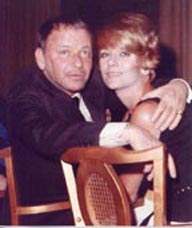
“Frank and I met on a blind date in New York in 1970 when I was the house model for Anne Klein,” she said. “I had had been working on an M.A. in International Relations at the New School before that. He was 23 years older than me but we clicked immediately…. On our first date He gave me his antique Dunhill lighter. Anne wanted me to look great every time I went out with Frank so once she loaned me a gorgeous mink coat. Frank loved the coat and complimented me on it but I told him the truth–that it wasn’t mine, that I had borrowed it for the evening. The next day I found an envelope filled with $100 bills and a note that said: ‘Buy your own mink coat.’ So I did.
“Anne Klein loved our affair and always dressed me when Frank and I went out. One night Frank asked me to go to the theater with Loel and Gloria Guinness. I was too young to know that Gloria Guinness was a renowned beauty and supposedly the most elegant woman in the world but Anne knew what I was up against so she dressed me in a gorgeous white silk dress, cut on the bias, topped by a spectacular orange silk patch work coat that Frank just loved because, as you know, orange was his favorite color.”
Nancy Gundersen Stone recollected sweet times with Sinatra. “We had a wonderful affair for two years that melted into a deep friendship for another two years… I loved Frank, but was never in love with him… I spent many, many week-ends at his house in Palm Springs and I have to laugh as I remember the deep freeze I’d always get from Dinah Shore and the girls who were pushing him to marry Barbara Marx…. He told me Ava had been the great love of his life and that that love almost ruined him. He never got over her—ever.”
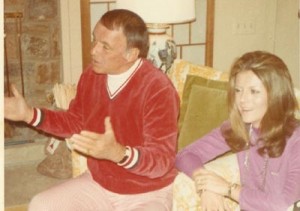
Blessed by good looks, a good education and Anne Klein, Nancy had the cachet (or “class” as Frank Sinatra said) to travel easily in all of his worlds. He flew her to Las Vegas for his shows and to weekend with him at publisher Bennett Cerf’s house in Westchester County. “I was not a show girl,” she said, “so he felt he could introduce me to all sorts of people.”
She also accompanied him to his mother’s house in New Jersey when he signed his record contract. She remembered Dolly Sinatra as “rawhide tough,” but adored by her son. “That night Frank wrote a check for her for $1 million.”
Barbara Sinatra writes in her memoir that Frank never discussed his finances with her. Yet he seems to have shared many such details with Nancy Gundersen. “When he drew up the trust funds for his kids he made sure that Frank, Jr. got his payout at the age of 21 but the girls, Nancy and Tina, could not get their money until they were 35. ‘Otherwise, they’ll marry bums,’ Frank said.”
Nancy Gundersen came to know Frank’s daughters very well, having spent so much time with them at his house in Palm Springs. “One night Frank was receiving an award at Chandler Center and he escorted Nancy Sr. and his daughters. I was driven to the ceremony by Sarge Weiss. It was a bit uncomfortable, especially when Nancy, Jr. pretended not to know me in front of her mother, but Tina, who is like her father, ran over to give me a big hug. Frank and I left right after for Palm Springs.”
Interesting to note that after 22 years of marriage to their father, Barbara Sinatra does not mention either of his daughters in her memoir. Since Frank Sinatra died in 1998, the three women have not spoken, except through lawyers. Their fights are primarily over money, although each was magnificently taken care of in Sinatra’s will. The two daughters have written books suggesting that the blond Las Vegas show girl who became their step-mother was not worthy of their father’s iconic name.
Nancy and Tina Sinatra, both of whom have been married and divorced never took their husbands’ names, preferring instead to go through life as Frank Sinatra’s daughters. And who could fault them? In its day, the Sinatra name could open any door. As Barbara Sinatra writes, she met presidents, prime ministers and potentates. She details the delights of being Lady Blue Eyes (the mansions, the mammoth jewels, the private planes, the famous friends) and the dangers (the violent fights, the black moods, the uncontrollable temper). She also dishes.
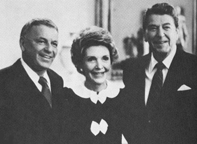 She dismisses former First Lady Nancy Reagan as a user. “[She] was never a close friend, and it had nothing to do with the fact that she seemed to have a crush on my husband…. I felt she took advantage of Frank’s huge heart…. During long distance telephone calls and their lunches together whenever they were in the same town, I think Frank became Nancy’s therapist more than her friend.”
After telling readers that her husband, “Charlie Neat,” was obsessively clean, took three showers a day and allotted $1 million a year to himself to lose at gambling, Barbara Sinatra writes that as his wife it was her job to vet the guest list of every party to which they were invited. If there was a guest that Frank did not like, Frank did not attend. When Henry Kissinger planned a dinner in Frank’s honor, he had to submit the guest list to Barbara. Unfortunately, for Kissinger, he had invited Barbara Walters, whom Sinatra detested, so Sinatra refused to go to the party. Stunned, Kissinger called Barbara Sinatra three times, begging her to get her husband to reconsider, but Sinatra was adamant. Mrs. Sinatra told the former Secretary of State that her husband would not go anywhere Barbara Walters was present. Finally, Kissinger had no choice but to disinvite Walters. Only then would Frank Sinatra agree to attend the party in his honor.
Right, wrong or rude, the man certainly did it His Way.

Photo credits: Nancy Gundersen with Frank Sinatra, courtesy of Nancy Gundersen Stone; Frank Sinatra 1986, Frank Sinatra with the Reagans in 1985, and the author in 1986 used with permission of the Estate of Stanley Tretick.
Cross-posted from Huffington Post