
General
The Hamptons
by Kitty Kelley
The little girl looked forlorn. Standing in the Starbucks line in East Hampton, she tugged at her mother’s cashmere sleeve, almost in tears. “Oh, Mummy,” she said. “I forgot to kiss Daddy good-bye this morning before he got in the helicopter.”
This child of the “one percent” summers with her prosperous parents on the luscious East End of Long Island known as “The Hamptons,” a term that annoys many locals, who prize the uniqueness of each little village and hamlet tucked into the 27 miles from Montauk Point to East Hampton, including Wainscot, Sagaponack, Bridgehampton, Water Mill, Southampton, Sag Harbor, Amagansett and Shelter Island, which can only be approached by ferry.
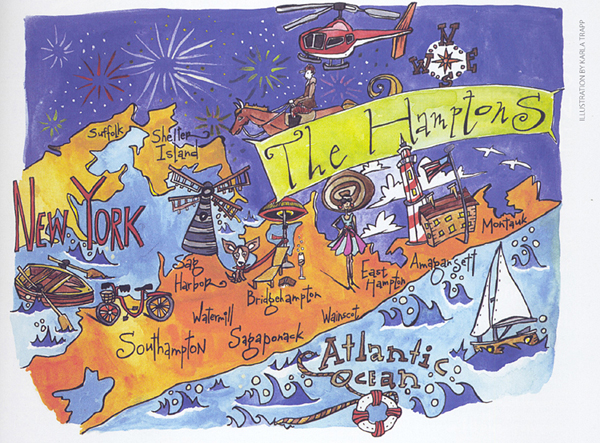
“The Hamptons” conjures the good life of pristine beaches, million dollar mansions, gleaming yachts, and emerald green golf courses where even the sand traps glisten. In addition, the area boasts windmills, horse farms, flowered meadows, rolling fields of corn, and acres of vineyards. The food is farm fresh and, just like Provence, there is a farmer’s market every day in a different town offering fresh fruits and vegetables, sunflowers, eggs still warm from the hen house and even fresh chicken.
For foodies, there are gourmet chefs and starred restaurants, notably Nick and Toni’s (East Hampton), Tu Tu Il Giorno (Sag Harbor), Tom Colicchio’s Topping Rose House and Pierre’s (Bridgehampton). The most romantic restaurant by far is the bricked alley of Sant Ambroeus (Southampton). The orchids cascading from the walls and candles flickering at small tables make you feel like Cinderella with two glass slippers, plus the fairy godmother who grants your every gourmet wish from fresh seafood to locally harvested wines. Plus—all the waiters look (and act) like Prince Charming.
“The Hamptons” also mean celebrities, celebrities, celebrities. In East Hampton you’re bound to see Alec Baldwin with his yogi wife, Hilaria, carrying their baby down Main Street. If you breakfast at the American Hotel in Sag Harbor, you can be sure the man ordering an egg white omelet is the former president. Bill and Hillary Clinton (a k a “Billary”) are summer regulars. Kitchen czarinas like Martha Stewart and Ina Gartner are fixtures as are tycoons like Ron Perlman (Revlon), Ronald Lauder (Estee Lauder), and Len Riggio (Barnes & Noble). Don’t be surprised if you see Howard Schultz, CEO of Starbucks, standing at the door welcoming customers.
Fashionistas love spotting Tory Burch, Calvin Klein and Ralph Lauren and fans occasionally glimpse Madonna, Paul McCartney, Jon Bon Jovi, Jerry Seinfeld, Sarah Jessica Parker, Mathew Broderick, Jennifer Lopez, Kelly Ripa, Andy Cohen, Gwyneth Paltrow, Mariska Hargitay and Christie Brinkley, who in her 60’s looks better than when she was as Billy Joel’s “Uptown Girl.”
The main streets of every town in the Hamptons are filled with bistro bars, patio restaurants, antique shops, and pricey boutiques. You’ll find many of your favorite labels at the shops of Ralph Lauren, InterMix, J.Crew, Wonder, Tory Burch, Michael Kors, Calypso, J. McLaughlin., Theory and Eli Tahari. In East Hampton you can buy a cashmere sweater for $1250 at Brunello Couchinelli or an $18 t-shirt from Bookhampton that says, “I Believe in Books.” (I skipped the sweater and bought the t-shirt).
While in East Hampton make your way to The Monogram Shop on Newtown Lane for anything you want personalized from finely stitched pillow cases, bathrobes and night gowns to beach bags, sun bonnets, glasses, placemats, napkins (paper or linen) stationary, invitations, and place cards for your dinner parties (the funniest being monogrammed Stop Talking beneath which the impish owner, Valerie Smith, wrote the name of Bill O’Reilly). She also sells 16 oz. shatter-proof glass cups that go in the dishwasher and—ta dah—predict presidential elections.
“The cups know,” said Smith. “The cups always know.” Since 1994 she has been monogramming political cups—last ones were Obama/Biden and Romney/Ryan. “I keep a daily tally of how many sold and post it in the window so passers-by can see the results, and every four years my cups have accurately predicted the presidency.”
Beyond the glitz and glamour of the Hamptons is a cornucopia of culture—theater, music, dance, art, film, and spectacular garden tours. Nearly every night in the summer there is a charity event open to the public for a price to raise money for every good cause from local schools and libraries to hospitals and hospices. Not to be missed is an evening of Shakespeare Under the Stars at Mulford Farm in East Hampton presented by HITFest (Hampton Independent Theater Festival). Bay Street Theater in Sag Harbor offers a summer comedy series and top-quality productions by Equity actors. One of the funniest evenings is “Celebrity Autobiography” at Guild Hall in East Hampton, featuring a troupe of actors reading inanities from books written by celebrities like Dolly Parton, Arnold Schwartzenegger, and Tony Danza.
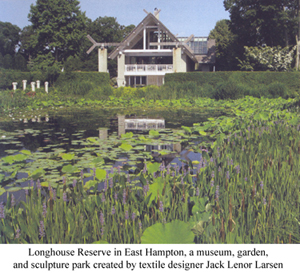 An absolute must-see is Longhouse Reserve in East Hampton, the 16 acre sculpture garden created by world-renowned textile designer Jack Lenor Larsen. He has filled his little piece of paradise with towering oaks, weeping Japanese cherry trees, and Hemlock hedges surrounded by flowers in full bloom year round. You will be mesmerized by the marriage of art to nature as you stroll through 37 pocket gardens under rose-entwined arches. Wandering around ponds teeming with lilies, and pools bedecked by outdoor furniture as colorful as a peacock’s feathers, you will see sumptuous sculptures–a deKooning here and a Chihuly there. Yoko Ono’s mammoth white marble chess set gleams in a green garden not far from an arresting fiberglass dome designed by Buckminster Fuller.
On summer weekends the main roads of the Hamptons are clogged with Jaguars and Ferraris. The traffic is bumper to rich bumper; crossing guards (try to) protect pedestrians and parking places are strictly monitored. A ticket will cost you more than the price of an upscale dinner. Fleets of jitneys arrive from Manhattan filled with Generation X-ers heading for summer rentals and Saturday night clubbing. The one-percenters fly in on private planes and then helicopter to their multi-million dollar mansions by the ocean. The sky traffic over the Hamptons on Friday afternoons and Monday mornings has kicked up such a kerfuffle that Sag Harbor recently held a town hall meeting to discuss the racket. The local newspaper headlined the story: “The Very Rich are Angry at the Extremely Rich,” and quoted one resident as saying: “When I look up at small planes and choppers, I see a fleet of middle fingers across the sky.”
While the Hamptons are famous for summer vacations, any season can be rewarding, especially without the hordes of tourists. The Baker House in East Hampton, features canopy beds, plus a spa and honor bar. So whether you choose the full celebrity throttle of summertime, the dialed-back leisure of spring, or the fireplace romance of fall and winter, the Hamptons promise a memorable trip.
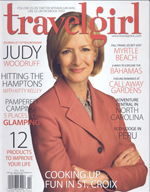
From Travelgirl magazine
Fall 2014
Statement, ASJA Awards Presentation, April 24, 2014
On April 24, 2014, Kitty Kelley was presented with the Founders’ Award for Career Achievement by the American Society of Journalists and Authors (ASJA) during a ceremony at the group’s 43rd annual writers’ conference in New York. The following are her remarks at the Awards Presentation.
My love affair with the American Society of Journalists and Authors began on September 21, 1983 when we were introduced by Frank Sinatra. That was the day he sued me for $2 million to keep me from writing his (decidedly unauthorized) biography. In court papers, he declared that he and he alone or someone that he authorized could write his life story. No one else was entitled to what he called his “right of publicity.”
ASJA immediately stepped forward and joined with other writers’ groups to protest Sinatra’s assault on the First Amendment. In a press conference, they said: “The apparent goal behind Sinatra’s filing of this suit is to scare Ms. Kelley away from her investigation and ultimately to force her to scrap the book.” They asserted that “the unauthorized or unblessed biography” is the essence of free speech and open commentary and declared that Sinatra’s lawsuit was an assault on all writers’ constitutionally protected freedom of expression and should be dismissed on its face.
This public stance stirred a great deal of publicity from outraged journalists, who wrote columns, editorials, and even a few cartoons. One of the funniest was drawn by Jules Feiffer, who showed a mug’s face under a snap-brim hat, swaying on skinny legs and snapping his fingers:
“I’m chairman of the Board. If some broad wantsa write a book about me… She gotta talk t’one of my boys who talks t’one of my other boys… who talks t’me. And MAYBE if the broad looks OK, I say, ‘Go Baby.’ Or Maybe I say ‘Shove it, Bimbo.’ And before she can write word one I sue her.
“So don’t give me any First Amendment crapola, I got the Frank Amendment and mine is bigger than hers. Ring a ding ding.”
After a year of litigation that cost me over $100,000 in legal fees, Sinatra finally dropped his lawsuit, but by then he had sent his message to my publisher and the rest of the world that he did not want the book written. Many people were too frightened to speak on the record, and some actually feared for their lives, but over the course of three years I managed to interview 800 people, including members of Sinatra’s family, his mistresses, co-stars, friends, neighbors, employees, FBI agents, a few antagonists, and a couple of mobsters.
In 1986 His Way: The Unauthorized Biography of Frank Sinatra was published, and– despite his threats– I lived to see the book become number one on the New York Times best seller list and sell more than 1 million copies in hardback. All very gratifying, but best of all was receiving ASJA’s Outstanding Author Award that year for “courageous writing on popular culture.”
Publication of the Frank Sinatra biography was a triumph for all non-fiction writers who struggle against immense pressure to find their way to examine the public figures who influence our society.
Thirty years ago ASJA made it possible for me to find my way– and for that I am profoundly grateful. I accept your award for Career Achievement because YOU made my career all it has been– and I thank you from the bottom of my heart.
by Kitty Kelley
ASJA Award
 The Board of the American Society of Journalists and Authors has voted to give Kitty Kelley the Founders’ Award for Career Achievement. According to Minda Zetlin, President, ASJA, “The award goes to a member whose ability to tell a story and whose style, range, and diversity of career exemplify the profession of independent nonfiction writer.” The award will be presented at a ceremony in New York on April 24, 2014.
Let Freedom Ring and Capturing Camelot Awards
Let Freedom Ring and Capturing Camelot both won USA Best Book awards.
More information here.
Let Freedom Ring won in the History: United States category. Read reviews of Let Freedom Ring here.
Capturing Camelot won in the Gift & Specialty Books category. Read reviews of Capturing Camelot here.
Kitty Kelley’s Capturing Camelot: Stanley Tretick’s Iconic Images of The Kennedys and Let Freedom Ring: Stanley Tretick’s Iconic Images of the March on Washington are available from Thomas Dunne Books in both hardcover and ebook formats.
Kitty Kelley on Book-TV
Kitty Kelley appeared on C-Span2’s Book-TV “In Depth” program on Sunday, Nov. 3, 2013, answering questions from host Peter Slen and from viewers for three hours. The show may be viewed online here.

Goosey Lucy and Gay Marriage
by Kitty Kelley
Gay marriage has jumped out of the closet on to the front page. Everyone from the President of the U.S. to retired four star general Colin Powell is embracing the issue, now supported by most Americans. Still, a few people like former First Lady Laura Bush appear to be conflicted. This week Mrs. Bush, who publicly supported gay marriage, now objects to appearing in an ad that carries her words of support.
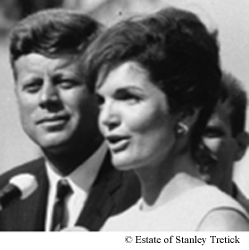 Presidents often disappoint, but first ladies rarely do. I became a student (and secret admirer) of first ladies after writing biographies of Jacqueline Kennedy Onassis (1978), Nancy Reagan (1991) and Barbara and Laura Bush (2004). Through years of research and reporting I’ve watched these unelected women enhance the presidencies of their spouses through deed and demeanor. They all seem to do it with style and grace and as a result they usually become even more popular than their beleaguered husbands (Lady Bird Johnson, Betty Ford and Michelle Obama).
These warrior goddesses stand stalwart in the face of their husbands’ scandals (Pat Nixon and Watergate; Nancy Reagan and Iran Contra; Hillary Clinton and Monica Lewinsky). They protect their young (Jacqueline Kennedy); they beautify their environment (Lady Bird Johnson) and they do good for others, even after leaving the White House. (The Betty Ford Clinic provides treatment for alcoholism; the Barbara Bush Foundation raises money for literacy; Rosalynn Carter travels the world for the Carter Center to promote mental health, and at the age of 91 Nancy Reagan still campaigns for expanded stem cell research.)
As first ladies these women stay above the political fray, avoid divisive muck, and glide like swans across ponds of public good will. Most write commercially successful memoirs of their days in the White House, where they became beatified, and as the wives of former presidents they continue burnishing their husbands’ legacies as well as their own.

For the most part first ladies seldom falter, which is why it was disappointing to read about the wife of a self-described “compassionate conservative” former president fumble on an issue of equal rights.
A group known as Respect for Marriage Coalition had launched a $1 million multi-media campaign last week that featured President Obama, former Vice President Dick Cheney, former Secretary of State Colin Powell and Mrs. Bush in their own words expressing support for the marriage rights of all committed couples. The group had taken what Laura Bush had said on the subject to Larry King on television: “When couples are committed to each other and love each other, then they ought to have, I think, the same sort of rights that everyone has.”
The former first lady’s words had reassured many who recalled with dismay her husband’s hard line on homosexuality. As Governor of Texas, George W. Bush said he supported the state’s law against sodomy “as a symbolic gesture of traditional values.” He opposed hate crimes legislation that would have protected gays. He also opposed gay adoption and gay marriage, and as President he proposed a constitutional amendment prohibiting same-sex unions.
 Granted, Laura Bush did not oppose her husband until after he had left the White House and would not have to pay the consequence of her words, but that seems to be in the tradition of Bush wives. Barbara Bush also waited until her husband, an ardent foe of abortion for twelve years, was no longer president before she declared publicly that abortion should be a “personal choice” and that she was pro-choice.
A year after Laura Bush’s 2010 interview on CNN, her daughter, Barbara Bush, taped a video for the Human Rights Campaign, now a sponsor of the Marriage Coalition. To date the former first lady’s daughter has not withdrawn her support for gay rights, but when Mrs. Bush saw her support in the Coalition’s television ad last week she immediately directed her spokeswoman to contact the media to say that the former first lady “did not approve of her inclusion in this advertisement nor is she associated with the group that made the ad in any way.”
The Coalition, comprised of 80 civil rights, family, health, labor, business, student, LGBT and women’s organizations, withdrew the ad in deference to Mrs. Bush and issued a statement, explaining they had used public comments from American leaders of both political parties who had expressed their support for civil marriage. “We appreciate Mrs. Bush’s previous comments but are sorry she didn’t want to be included in an ad.”
One can only wonder why the former first lady chose to backtrack on an issue that is supported by most Americans, who believe that marrying the person you love is a fundamental freedom and Constitutional right for everyone, including gays and lesbians. Polls show that a majority of the country believes that continuing to deny gays and lesbians the freedom to marry constitutes discrimination, and those who personally oppose marriage equality accept that it is likely to become a reality within the next decade. Even Congress has jumped on board. Bills were introduced in the Senate and the House this month to change the definition of “spouse” in the U.S. Code so that same-sex married service members can get equal benefits.
 Surely Laura Bush, a former librarian, who as First Lady frequently posed for photographs reading to children, knows the folk tale of Chicken Little, who believes the sky is falling when an acorn drops on her head. Terrified, she decides she must tell the King and on her journey to the castle she meets a goose, a hen and a turkey– Goosey Lucy, Henny Penny and Turkey Lurkey. Within moments they are cornered by a fox–Foxy Loxy–who threatens to eat them. In the happily-ever-after version only Goosey Lucy escapes. The morale, we are told, is not to be a chicken but to have the courage to stand up–a quality found in most first ladies.
Cross-posted from Huffington Post
Obama and the Legacy of Camelot
by Kitty Kelley
When Caroline Kennedy endorsed Barak Obama in 2008 as her father’s rightful heir she laid upon him the mantle of Camelot, and the enduring mystique of John F. Kennedy, who, according to polls, continues to be America’s most beloved president. Comparisons between the 35th and 44th presidents have been inevitable, and while there are striking similarities between the two men, there are also distinguishing differences.
Both rose to the nation’s highest office as junior U.S. Senators with scant legislative achievements to their credit. The man from Massachusetts served three terms in the House of Representatives before he won his Senate seat in 1952 and began campaigning for national office, running for Vice President in 1956 and for President in 1960. Obama, a state legislator in Illinois for seven years, began his run for the White House shortly after being elected to the Senate. Both men broke the barriers of bigotry to reach the highest office in the land–Kennedy as the first Roman Catholic; Obama as the first African American.
Erudite Ivy Leaguers, each seemed blessed with the gift of prose. Kennedy wrote three books, and won a Pulitzer Prize for Profiles in Courage; Obama made millions writing his best-selling memoir, Dreams from My Father. As a Boston scion and Harvard graduate, JFK. always smarted at being rejected for a seat on the Harvard Board of Overseers; Obama left Harvard with the distinction of having been the first person of color to be elected president of the Harvard Law Review.
 Both men possessed extraordinary talents for oratory and inspired their generations with the poetry of hope–“the thing,” Emily Dickinson described, “with feathers that perches in the soul.” Their messages resounded for a nation grown restless after eight years of a Republican administration. Each man came to the presidency with their party in control of Congress, and each used that power to effect sweeping change. Kennedy introduced the most comprehensive and far-reaching civil rights bill, which was not passed on his watch, but became law under his successor. Obama signed the Affordable Care Act of 2010 which reformed health care to provide insurance for all Americans. Kennedy ordered federal departments and agencies to end discrimination against women in appointments and promotions; Obama signed the Lilly Ledbetter Act to provide fair pay in the work place. In addition, he succeeded in getting a measure passed to end discrimination against gays in the military.
Both Kennedy and Obama exuded a dash of glamour in their roles as Commander-in-Chief and became the darlings of Hollywood. As President, each brought to the White House a fashionable and accomplished First Lady, two adorable young children, and scene-stealing pets. Yet as beloved as each became, both men stirred ferocious passions and dangerous threats from extremists who accused them of treason.
As notable as their similarities are the differences which define and separate them. Kennedy grew up with immense wealth and the high expectations and powerful connections of his father, the former Ambassador to the Court of St. James, who was the 14th richest man in America in 1960, worth more than $400 million. Obama, a fatherless child, forged his way on the wings of a single working mother, who wandered the world and left her son to the loving care of her parents. As a young man he borrowed thousands of dollars to finance his education and was not able to repay his student loans until he was 43 years old.
Both elusive men, Kennedy and Obama cared mightily about their public image, not an insignificant concern for politicians. Kennedy, who worried about being portrayed as a rich man’s dilettante son, would not allow photographs inside Air Force One, saying it would look like a playboy’s luxury. Obama made sure cameras never caught him smoking cigarettes. Each understood the mesmerizing power of appearances and knew as the actor Melvyn Douglas says in the film Hud, “Little by little the look of the country changes just by looking at the men we admire.”
Both presidents tangled with corporate America and drew the ire of big business. Kennedy blasted the steel industry in 1962, saying their price increase was “unjustifiable and irresponsible.” Obama, a community organizer, championed the middle class, challenging Wall Street when he enacted financial regulatory reform, and demanded that the richest Americans to pay their full share of taxes.
Each had to find his way through military quagmires left by their predecessors. Kennedy was haunted by the Bay of Pigs invasion but carried the country through the Cuban Missile crisis. He later increased the number of US military advisers to South Vietnam to more than 16,000. Obama came to the White House determined to end the Iraq War which he did by December 2011. After sending 33,000 more U.S. soldiers to Afghanistan as part of a strategy to downsize the American commitment there, he vowed to end that war by 2014.
Politically, both men made judicious choices in their running mates, but Kennedy never gave Lyndon Baines Johnson the full partnership that Obama accorded to Joe Biden.
Kennedy left behind the Peace Corps, the Nuclear Test Ban Treaty and the promise of a man on the moon within the decade. Obama’s legacy must be left to the historians of tomorrow but at the dawn of his second term, following an inauguration that coincided with the fiftieth anniversary of President Kennedy’s last year in office, it is reassuring to believe that each man dedicated his presidency to setting the country’s course true north.
(Photo: President Barack Obama looks at a portrait of John F. Kennedy by Aaron Shikler, taken by official White House photographer Pete Souza)
Cross-posted from Huffington Post
Review of American Lady
By Kitty Kelley
 The jacket copy makes your mouth water with tantalizing promises of wealth, glamour and power. Even the title bespeaks upper-class gentility: American Lady: The Life of Susan Mary Alsop (Viking). This biography by Caroline de Margerie is the story of “the second lady of Camelot.” Many of us thought in the Kennedy administration that title belonged to the vice president’s wife, Lady Bird Johnson. While we’re never told who bestowed the honorific on Mrs. Alsop, we are assured that she is “an American aristocrat,” who “reigned over Georgetown society for four decades, her house a gathering place for everyone of importance, including John F. Kennedy, Katharine Graham and Robert McNamara.”
As someone who lives in Georgetown and enjoys reading about the myths of Camelot and American aristocrats, I could hardly wait to gobble up this book.
Perhaps the author, a member of the Conseil d’Etat, the highest administrative court in France, and once a diplomat, could not shake her silk stocking background long enough to probe beneath the surface. Or maybe she drew too close to Mrs. Alsop’s family, who gave her access to letters, papers and diaries that she barely quotes. Perhaps it was the author’s intercontinental collaboration with her sister, whom she credits with helping her complete the book. Then again, it might be the translation from French to English that makes this book (at 256 pages) read like biography lite.
“Slim” is the word de Margerie uses to describe Mrs. Alsop, an understatement for the stick-thin woman I met in Washington, D.C. (we went to the same Georgetown hairdresser). At 5’7” she was almost skeletal and appeared to weigh no more than 95 pounds, with blue-veined skin tissued over protruding bones. Even her son, William S. Patten, described his mother as “anorexic.” Yet her biographer chooses a polite characterization that is fathoms from the destructive disease of anorexia.
“Slim” seems to be the operative word for this book, whose euphemisms keep readers removed from knowing the woman whose life intersected with many charismatic figures of her era — Franklin Delano Roosevelt, Winston Churchill, Greta Garbo, Noel Coward, Edith Wharton, Brooke Astor, Ho Chi Minh, the Duke and Duchess of Windsor, and President and Mrs. John F. Kennedy.
Susan Mary Jay Patten Alsop (1918-2004) was the great-great-great-granddaughter of John Jay, one of the Founding Fathers, who signed the Treaty of Paris in 1783 and became the first chief justice of the United States. Born into a revered American family, she declared she saw “no future in being an ordinary person.” She didn’t even like associating with ordinary people. According to her biographer, “She had always preferred lords to cowboys.”
Born in Rome, Susan Mary, as she was called, grew up in South America, traveled in Europe, lived in Washington and New York, and summered in Maine. She graduated from the Foxcroft School, took a few courses at Barnard College and married at the age of 21 after meeting Bill Patten (Harvard, Class of 1932), nine years her senior. He was severely asthmatic, like her father, declared 4F and unfit for military service. So his mother-in-law, Mrs. Jay, got him hired by the U.S. State Department to work for Sumner Welles, undersecretary to Cordell Hull. Patten’s first assignment was Paris, where he and Susan Mary lived from 1945 to 1960, when he died of emphysema.
Susan Mary soon fell out of love with her “sickly but sweet” husband and became besotted with their close friend, Duff Cooper, the British ambassador to France (1890-1954), the great love of her life. Her biographer maintains that Bill Patten “never showed signs of torment or bother” over his wife’s affair, and Susan Mary “was convinced he did not know.” She gave birth to Cooper’s son in 1946 and kept the paternity secret from her husband. She finally told her son when he was 47 who his real father was.
Three months after Bill Patten Sr. died, his Harvard roommate, Joseph Alsop, proposed. A powerful (and pompous) political columnist, he was syndicated in over 300 newspapers. After the election of John F. Kennedy, Alsop decided he needed a hostess to entertain the president and first dady so he wrote to Susan Mary, saying they could become a part of history if she married him. He admitted he was homosexual, said he did not expect her to be in love with him and that she could take a lover at any time. Reckoning that her son and daughter needed a stepfather and she needed a place in Washington society, Susan Mary accepted. The marriage did not last, but their friendship endured to the end of their lives.
Following her separation from Alsop, she asked him for permission to continue using his name. At the age of 56 she became a writer and published her first book, To Marietta from Paris: 1945-1960, a compilation of her letters to her best friend, Marietta Peabody Fitzgerald Tree. She published three more books and then became a contributing editor to Architectural Digest for many years.
Toward the end of her life she was plagued by near blindness, drug addiction and alcoholism. She died at the age of 86 in the Georgetown house she had inherited from her mother. Her obituaries barely mentioned her career as a writer, celebrating her instead as a “socialite,” “hostess” and “Washington doyenne.” Most assuredly she would have been pleased by the social plaudits because her first priority as an American lady was maintaining her place in society. Readers accustomed to hearty biography will go away hungry from this little morsel, feeling deprived of the banquet promised on the book jacket.
Cross-posted from The Washington Independent Review of Books
Becoming an Independent Writer
Video of Kitty Kelley being interviewed by Stephen Hess, author of Whatever Happened to the Washington Reporters, 1978-2012:
http://www.brookings.edu/blogs/up-front/posts/2012/09/11-kitty-kelley-hess
Jackie Oh! Ebook
 Jackie Oh!, Kitty Kelley’s first biography, is now available from Amazon in Kindle format. This ebook edition of the 1978 bestseller includes a new Afterword by the author. There is also a new selection of photos by Stanley Tretick–many of them not previously published (and not to be published in Capturing Camelot).
The Kindle ebook Jackie Oh! can be read on a Kindle, but it can also be read in the free Kindle reading apps for iPad, iPhone and iPod Touch, Android, Blackberry, Windows 7 phone, PC, or Mac, or even online with the Kindle Cloud Reader.
“It’s hard to pass up a good, gossipy story about a chic, super-rich former First Lady.” —Houston Chronicle